Frenzel Equalization | The Core Skill Every Freediver Needs to Learn
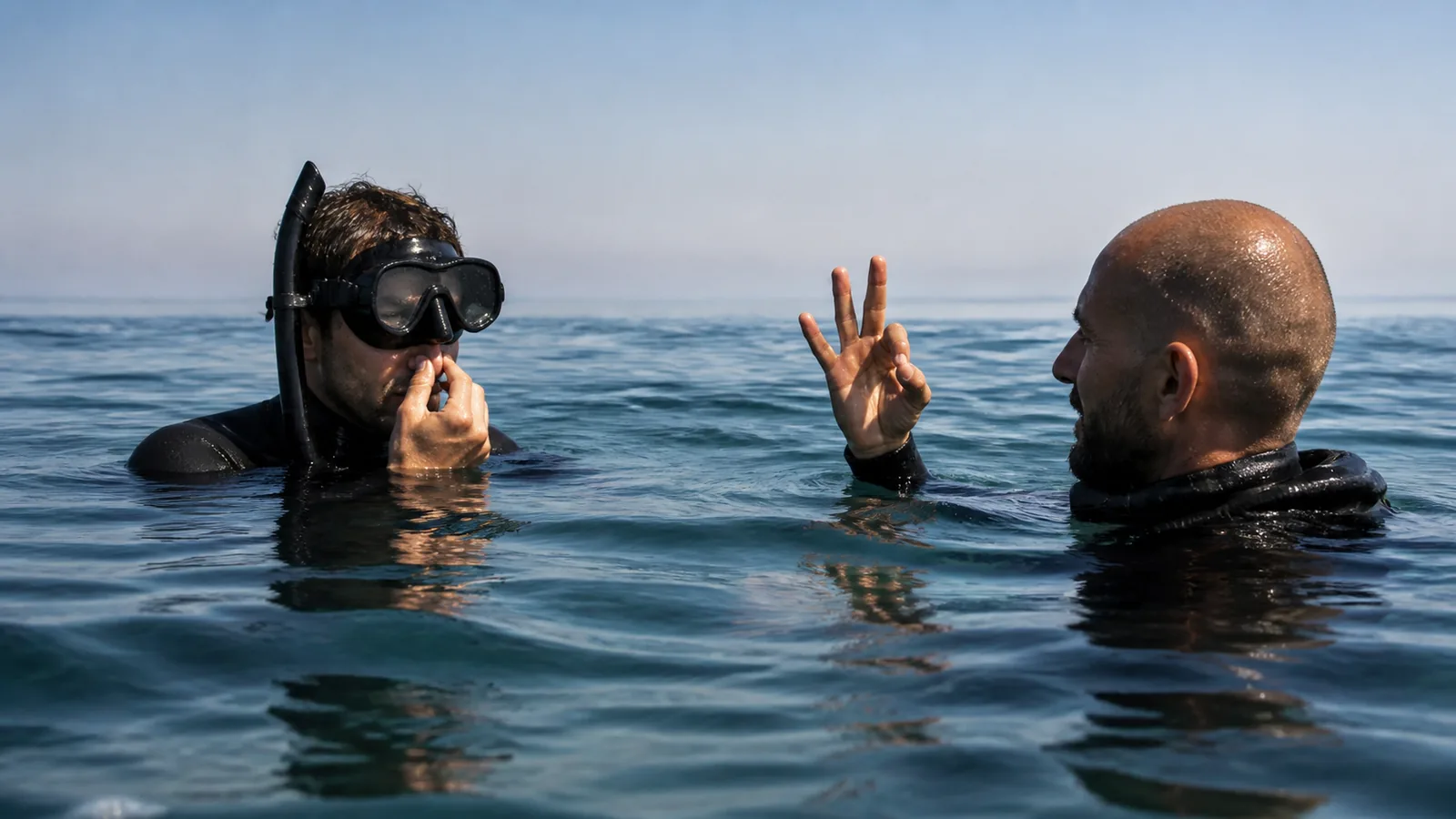 Frenzel equalization technique
First, the question you care about most: what is Frenzel actually for? It is a way to equalize your ears during a freediving descent by pinching your nose with your fingers, closing your glottis with tongue movement, and pushing a small amount of air into the Eustachian tubes. Almost all freedivers eventually switch to Frenzel, because it takes less effort and is more efficient than Valsalva (the valve method), and it does not depend on the air in your lungs — at depth your lungs are already compressed, so Valsalva simply cannot be done. Frenzel is the key to depth.
In one sentence: Frenzel is not an "advanced technique." It is a basic skill every freediver has to master sooner or later. The earlier you learn it, the earlier you leave ear equalization bottlenecks behind.
Valsalva vs. Frenzel: Why Valsalva Doesn't Work
The point of equalization is to keep the air pressure inside your middle ear equal to the surrounding water pressure. The deeper you go, the greater the outside pressure, and the middle ear must keep taking in air to offset it.
Valsalva: pinch your nose and blow hard with your lungs/abdomen, pushing air through your throat into the Eustachian tubes. This is what most people are taught on their first dive — simple and intuitive, but it has one fatal flaw: it depends on the air in your lungs. Once you descend past a certain depth, your lungs are compressed and the amount of usable air in them drops sharply, so Valsalva stops working. Many beginners get stuck at 5-8 meters for exactly this reason — not because their equalization technique is poor, but because they are using the wrong method.
Frenzel: pinch your nose, close your glottis (the back of your throat), and push your tongue upward like a piston, squeezing the air in your mouth and throat into the Eustachian tubes. Its air source is your mouth and throat — those few milliliters of air have nothing to do with your lungs and are not affected by depth. So Frenzel can be done at any depth (as long as there is air in your mouth), and it takes little effort.
How to Practice Frenzel: Step by Step
Step 1: Find the Feeling of a Closed Glottis
Start on land, not in the water. Open your mouth and "hold" a breath at the back of your throat — the natural closing action of your throat when you hold your breath, like the unconscious breath-hold you take before lifting something heavy. Once you find that feeling, keep your glottis closed, pinch your nose, and try to push your tongue upward, imagining that you are squeezing a small pocket of air from the back of your mouth into the Eustachian tubes.
Step 2: Speed Practice (the "Tongue Snap" Method)
Keep your glottis closed, pinch your nose, and snap your tongue quickly upward — the same back-of-the-tongue action you use to make a "g" or "k" sound. Each snap should produce a faint "pop" in your ears. If you do not hear it, check two things: is your glottis really closed? Is your tongue pushing up rather than pulling back? You can practice in front of a mirror to see whether the base of your tongue moves upward.
Step 3: Practice Upside Down or Head-Down
On land, with your head down (lying face down on a bed, hanging upside down, or in a yoga headstand), practice Frenzel. With your head down, the opening of the Eustachian tubes shifts position and is harder to open than when you are upright — this mimics the head-down position underwater. If you can do it easily while upside down, it will be much easier in the water.
Step 4: Practice in the Water (Shallow, with a Buddy Watching)
In a pool or shallow water (3-5 meters), descend slowly with a buddy watching. Do one Frenzel every 1-2 meters of descent. Do not wait until your ears feel pressure — the principle of Frenzel is "early, gentle, frequent": equalize as soon as you feel slight pressure, not when it hurts.
Common Reasons It Fails and How to Fix Them
| Problem | Cause | Fix |
|---|---|---|
| Nothing happens in your ears even though you did it | Your glottis is not fully closed and the air leaks back into your lungs | Practice closing your glottis again, using the feeling of "locking your throat" while holding your breath |
| You cannot do it past 5-6 meters | There is no air left in your mouth — your abdomen has pulled it back | Relax your abdomen; do not let your diaphragm pull the air back into your lungs |
| Pinching your nose hurts | Your fingers are in the wrong place, or you are pinching too hard and pressing on the cartilage | Adjust your finger position and use the pads of your fingers, not your fingertips |
| You have practiced a long time and still cannot do it | Your tongue cannot move independently | Try the "tongue snap drill": pinch your nose and repeat a fast g-g-g, making each snap push one pulse of air |
| One ear equalizes and the other does not | The two Eustachian tubes open differently (a normal physical difference) | Tilt your head slightly toward the ear that will not equalize and keep doing Frenzel |
Frenzel and Ear Safety: Limits You Must Not Cross
- Stop at the first sign of pain: if you feel any sharp pain in your ears, stop the descent immediately and ascend a little. Do not stay at that depth and force the equalization. Forcing it can cause middle-ear barotrauma or a ruptured eardrum, which can end your diving career.
- Do not blow hard: Frenzel relies on precise, short pressure created by tongue movement, not on forceful blowing from your lungs. If your ears will not clear, do not increase the force from your abdomen — that is the Valsalva approach, and at depth it fails and can even be dangerous.
- Do not dive with a cold, a blocked nose, or allergies: when the Eustachian tubes are congested or swollen they can barely open, and forcing it easily leads to injury. Wait until you have fully recovered before getting back in the water.
- Do not swallow saliva instead of doing Frenzel during a descent: swallowing moves only a very small amount of air, and it is not controllable, so it is completely unreliable at depth.
Frequently Asked Questions (FAQ)
Q: How long does it take to learn Frenzel?
A: Some people get it in a single lesson; others practice for months before it clicks. The main difference is how well you can control your tongue muscles independently — this relates to your athletic background and body awareness, but it is not a question of "talent." Practice the tongue snap on land for 5-10 minutes a day, and you may get it in one or two weeks.
Q: I cannot do Frenzel past 5 meters of descent. What should I do?
A: Nine times out of ten there is no air left in your mouth — your abdomen/diaphragm has pulled it back into your lungs. During practice, consciously relax your abdomen and keep the air in your mouth and throat. Try pinching your nose and doing Frenzel on land while touching your belly — your belly should be soft and still.
Q: What is the difference between Frenzel and BTV (Béance Tubaire Volontaire, voluntary opening of the Eustachian tube)?
A: BTV means opening the Eustachian tubes voluntarily without pinching your nose; it relies on controlling specific muscles. Only a few people can do it naturally, and most need long-term training to master it. Frenzel uses nose pinching plus tongue pressure and is the mainstream method. Most freedivers use Frenzel.
Q: Is Frenzel suitable for older adults or children to learn?
A: Frenzel itself has no age limit, but the Eustachian tubes change with age. Children's Eustachian tubes are shorter and straighter, which actually makes equalization easier; older adults with chronic rhinitis or reduced Eustachian tube function may need to consult an ENT doctor first.
Frenzel is the first hurdle on the freediving path, and the most important one. Once you clear it, descending is no longer the torment of "how much ear pain before I have to stop," but the freedom of "I stop when I want to." A few minutes of practice on land each day, together with a qualified instructor, and this hurdle is nothing to fear.
This article is for general information only and does not constitute instructional advice. Freediving is a high-risk activity. Please learn and practice equalization techniques under the guidance of a certified instructor. If you have any ear, nose, or throat health issues, consult a doctor first.