How to Adjust Freediving Weights | Buoyancy Test, Weight Belt and Safety Limits
 How to Adjust Freediving Weights | Buoyancy Test, Weight Belt and Safety Limits
First, the question you care about most: how much weight should you add for freediving? There is no such thing as a "standard number of kilograms" — your weight depends on your body weight, wetsuit thickness, body fat percentage and dive depth, and can only be found on site with a buoyancy test. Anyone who tells you "I'm 70 kg and I add 5 kg" — that number means nothing for you.
And weighting is the one part of freediving where you can least afford to be careless: too much weight is directly linked to the risk of drowning after a shallow-water blackout (BO). This article explains the test method, how to choose a weight belt, and the safety limits.
First, understand this: you must be positively buoyant at the surface
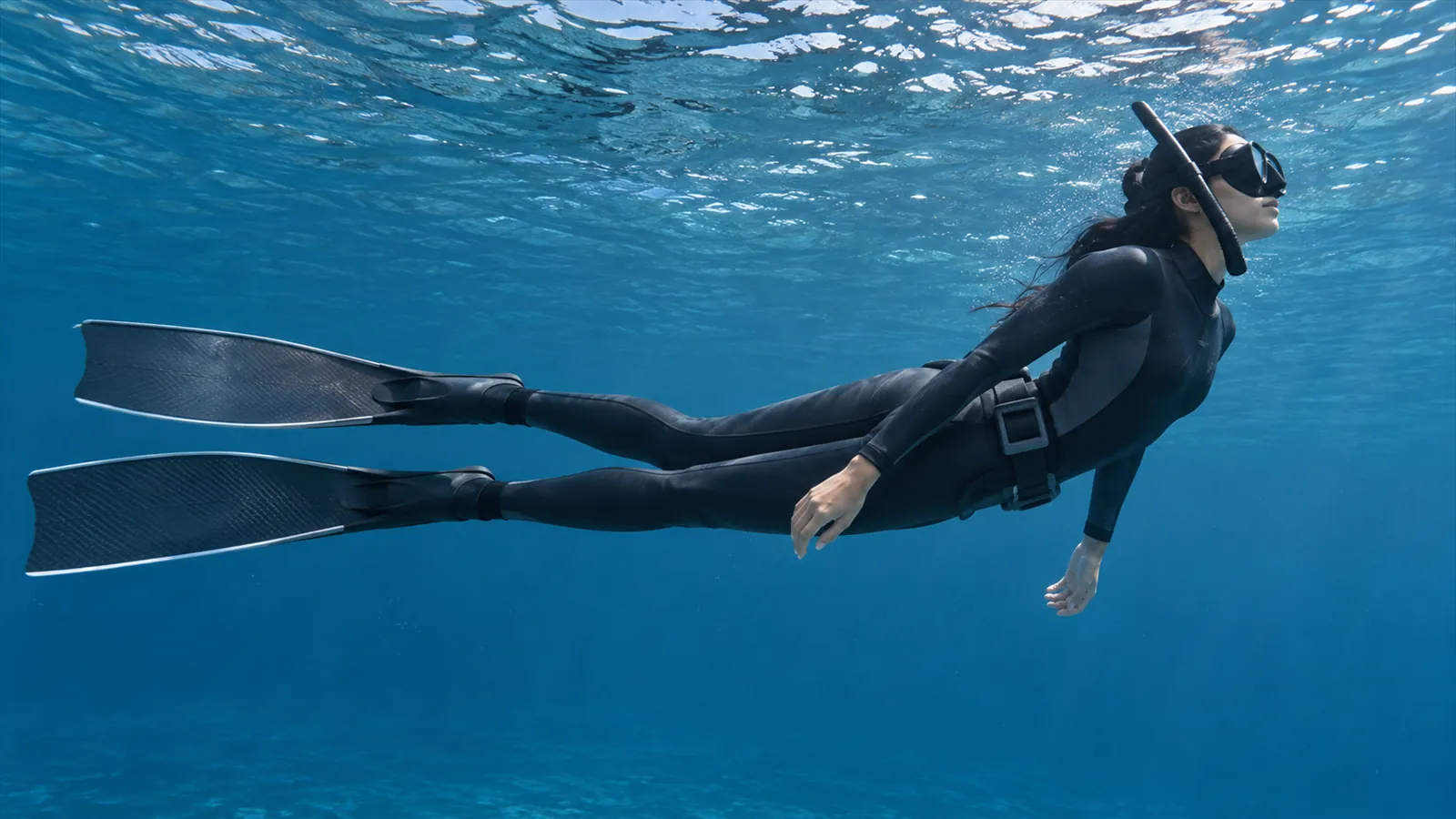
Among the principles of freediving weighting, the most important one is: at the surface (especially in shallow water, where BO happens most often) you must stay positively buoyant — you should float without kicking.
There is no single fixed value for neutral depth. It depends on your planned maximum depth, your training level, your wetsuit and the water, and is determined by your instructor based on your situation. Only below that do you enter negative buoyancy and naturally go into free fall. Descent and ascent come from posture and buoyancy change, not from kicking hard the whole way.
- Too little weight: the descent is hard work, you have to kick all the way down, oxygen consumption rises sharply, and you are tired before you reach your target depth;
- Too much weight: the ascent is hard work and oxygen consumption rises; worse still, it eats into your buoyancy reserve — if a BO or a loss of motor control happens at the surface or in shallow water, your head sinks more easily and your airway is more likely to go underwater, which significantly increases the risk of drowning.
So weighting is not about "more is easier" — it is about being exactly right.
Surface buoyancy test: the only reliable method
Standard procedure (always with an instructor or safety diver watching):
- Enter the water in your full set of equipment; the wetsuit must be fully saturated (a dry suit, or a wetsuit that has not soaked through, will give you a reading that is off — the most accurate reading is usually taken after the first dive, once the wetsuit is soaked through);
- Breathe normally at the surface with your body upright and your arms hanging naturally;
- With a normal inhale, you should float comfortably at the surface (a common teaching reference is that your eyes are roughly level with the water surface);
- After a passive exhale, you should still be able to stay afloat; if you start to sink as soon as you exhale, your weight is too much and you need to remove weight and test again;
- If the reading is off, add or remove weight, starting with small steps (0.5–1 kg) — do not add 2 kg at once.
Note: agencies do not teach exactly the same standard for "what happens after the exhale". Some standards are stricter (requiring you to still float after a passive exhale), others are more lenient. Follow your own agency's current standard and your instructor's judgment; do not apply something you read online to yourself.
Three preconditions for the test — if one is missing, the result is not accurate:
- The wetsuit must be fully saturated;
- You must wear all the equipment you will actually use (fins, mask, whether you wear a hood);
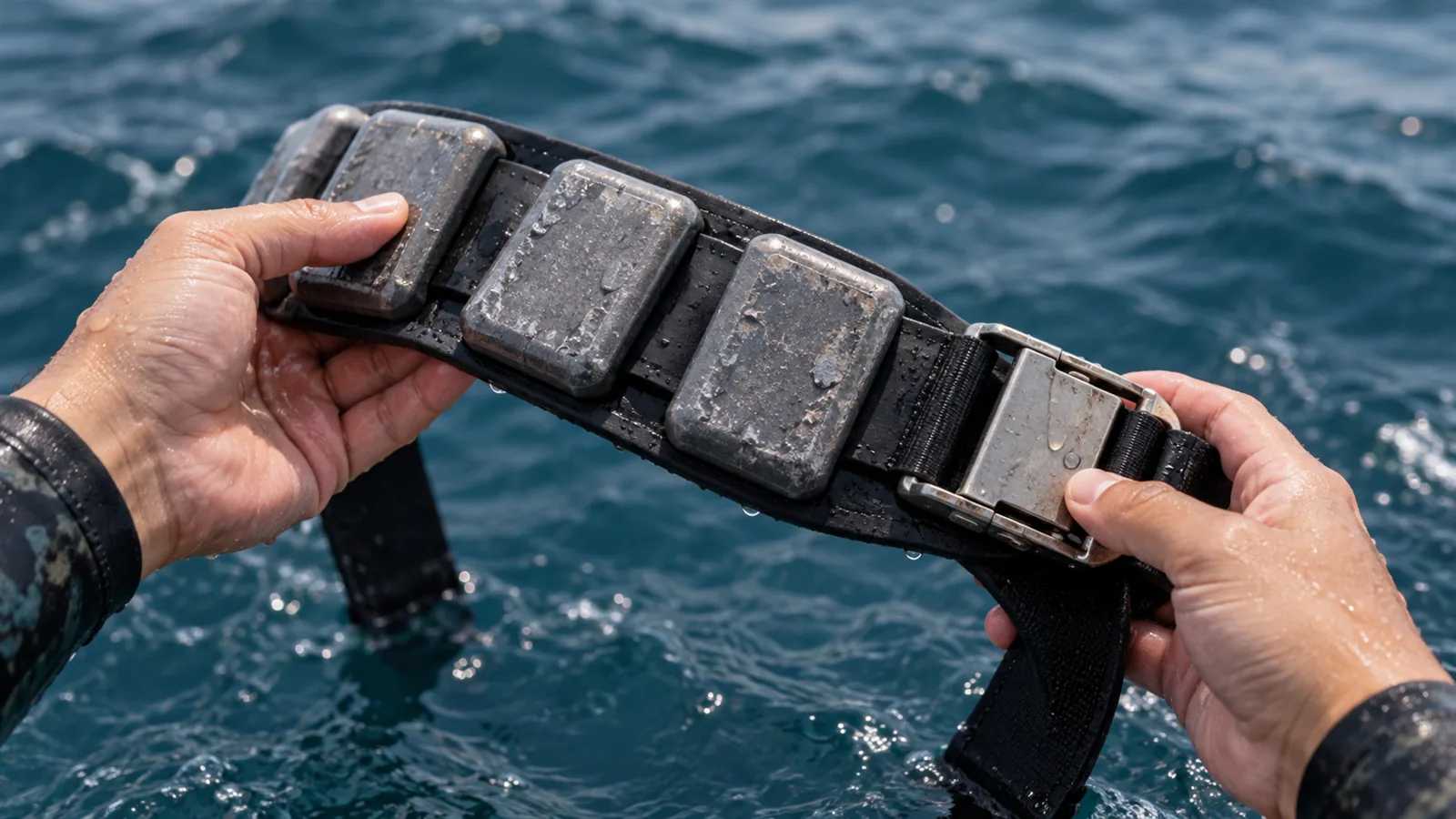
- The weight belt must have a quick-release buckle, and you must confirm that you can undo it underwater with one hand in one motion — this one is life-saving, not optional.
How to choose a weight belt
| Type | Features | Recommendation |
|---|---|---|
| Rubber/elastic weight belt | Tightens as the wetsuit compresses on the descent and does not slide | The mainstream choice in freediving |
| Nylon webbing | Cheap and general purpose | Loosens on the descent and shifts easily |
| Quick-release buckle | Can be released quickly with one hand | Must have |
| Weights | Lead blocks, soft lead, shot lead | Soft lead sits closer to the body; shot lead allows fine adjustment |
| Neck weight | Often used in some pool dynamic training to help keep a horizontal posture | Whether to use one for depth disciplines must be assessed by an instructor; the key point is whether the specific item can be removed quickly in an emergency |
Weight distribution also matters: if all the lead is gathered on one side of the waist or at one point at the front or back, your body will roll side to side or tilt forward and back; splitting it into several pieces spread evenly along the belt gives a much steadier posture.
Also, the weight belt goes on the outside over all other equipment, with the buckle at the front and not covered by other straps or pockets.
About dropping weights, one thing must be practised with your buddy: it is not only you who must be able to undo the weight belt underwater with one hand — your buddy must also know your weighting system and know how to drop the weight quickly if you lose consciousness or lose motor control. Only after practising this once under an instructor's guidance do you really know it.
How weighting differs by setting
- Pool static apnea: usually done at the surface, with the smallest weight requirement;
- Pool dynamic apnea: the goal is to be close to neutral at the depth you actually swim at. The exact depth and weight must be determined by testing, based on the pool environment, wetsuit and training plan;
- Thin tropical wetsuit (1.5–3mm): small weight requirement;
- Thick wetsuit for cold water (5–7mm): the wetsuit itself is very buoyant and compresses noticeably on the descent, so the weight needed changes sharply between shallow and deep;
- Deep dives: weight must be confirmed in stages under the supervision of the line, instructor and safety diver; you must never add weight yourself to test depth;
- A new wetsuit, a change in body fat, or a switch between salt water and fresh water all require a new test. Note that "must retest" does not mean "must change your weight" — if the new wetsuit has similar specifications, the test may show no change is needed. Fresh water is less buoyant than salt water, so the same weight becomes too much in fresh water.
Six safety limits
- Never add weight just to "sink faster". Sinking fast is not a skill; floating back up safely is.
- The weight belt must release quickly with one hand; check it once before entering the water, and your buddy must be able to release it too.
- Follow the one-up, one-down buddy system: any breath-hold in the water must have a buddy with rescue skills present and watching over you specifically — with close attention to the final part of the ascent and the recovery after surfacing, not each diving separately.
- Never hyperventilate before a breath-hold. Fast, deep breathing only lowers carbon dioxide and delays the urge to breathe, which makes a hypoxic blackout come with even less warning.
- Know how to tell the signs apart: if you keep sinking without kicking → your weight may be too much; if you keep floating up without kicking → your weight may be too little. Free fall should only happen below your planned neutral depth, not "sinking in deep water is always normal".
- If a BO, a loss of motor control or suspected water inhalation happens, stop diving for the day immediately, follow the rescue procedure and seek a medical assessment — even if you appear to have recovered, do not get back in the water.
Common questions FAQ
Q: How much weight does a 70 kg person usually add? A: There is no general answer to this question. Body fat percentage, wetsuit thickness, equipment buoyancy and dive depth matter far more than body weight. The only reliable way is to do a surface buoyancy test.
Q: What happens if I add too much weight? A: You have to kick more on both the descent and the ascent, and oxygen consumption rises. More dangerously, it reduces your buoyancy reserve — if a BO or a loss of motor control happens, your airway is more likely to go underwater, which increases the risk of drowning (the actual outcome also depends on whether you are found in time and whether the weight can be dropped quickly).
Q: Do I need weight for dynamic training in a pool? A: Training dynamic in a wetsuit usually still needs weight, with the goal of being close to neutral at the depth you actually swim at. Static apnea is done at the surface, where the weight requirement is usually smallest. How much exactly is again determined by a buoyancy test.
Q: I have a new wetsuit — do I need to change my weight? A: You must do a new buoyancy test, but whether to adjust your weight depends on the test result. With a wetsuit of similar specifications, the test may show that no change is needed at all.
Q: What happens if the weight belt will not come off? A: In an emergency, the weight belt is key to getting you out of the water. A quick-release buckle that will not release is the same as no quick-release buckle — test it once before entering the water, and have your buddy test it too.
This article is for general information only and does not constitute training advice. Weight and buoyancy settings must be confirmed under the supervision of a certified instructor or safety diver. Freediving is a high-risk activity; learn under a certified instructor and always follow the buddy system.