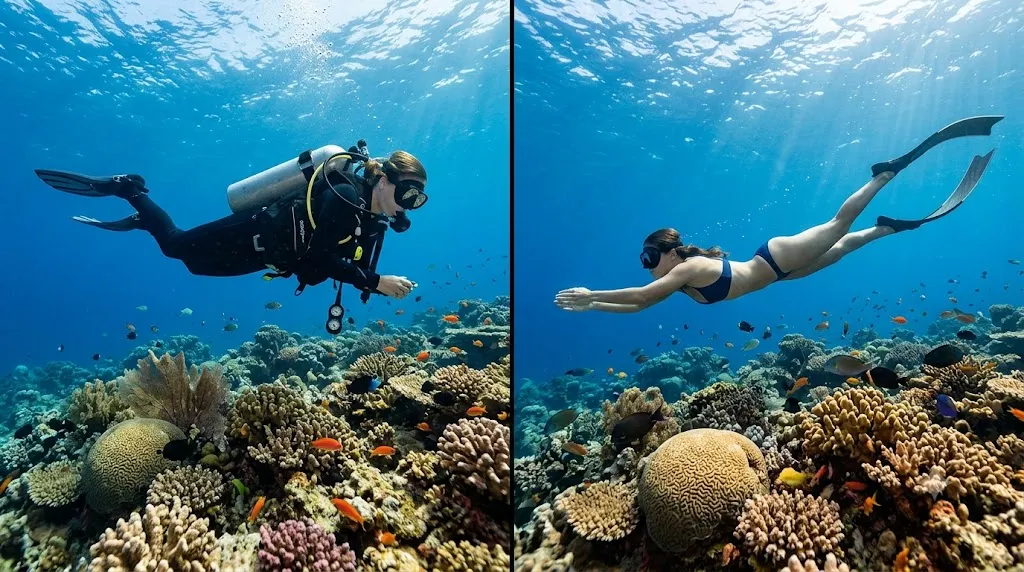
The most direct difference: is there a tank?
The biggest difference between freediving and scuba diving, and the easiest one to spot: scuba divers carry a tank and breathe continuously underwater, while freedivers descend on one breath and return on that same breath.
But the real differences go far beyond equipment. The experience, the feeling and the risks are completely different too. Someone put it well: “If you want to explore the outside world underwater, put on a tank. If you want to explore your own inner world underwater, you don't need one.”
Observing marine life: quiet vs. long-lasting
The strengths of freediving are “quiet” and “flexible.” Without a tank holding you back, you can move more freely — keep up with fast-moving schools of fish, quietly approach a cuttlefish, or even come face to face with a whale without disturbing it. Because you produce no bubbles, fish are not scared away, and you can easily pass through a school without scattering it.
The strength of scuba diving is “time.” You can stay underwater longer and watch the behavior of marine life in detail — how they feed, how they interact. The same coral reef actually looks very different to a scuba diver and a freediver — in freediving there is not enough time for your eyes to slowly adapt to the changing light, so the colors and details you see are naturally less rich than in scuba diving.
Range of exploration: depth vs. flexibility
Scuba diving has a clear advantage in range of exploration, especially in environments such as wrecks, caves and canyons. You can stay longer, cover greater distances and dive deeper (recreational scuba usually reaches 30-40 meters), with relatively manageable risk.
Freediving wins on flexibility. Without equipment constraints, freedivers can move more easily through gaps in the reef and get in and out of caves more conveniently. The entry barrier is also lower — you only need to take a beginner freediving course and find a buddy to start exploring. Scuba divers usually need to earn the relevant specialty certification before doing cave or wreck diving.
Communicating with your buddy: different ways of sharing
Freedivers spend only one or two minutes underwater on each dive, then surface to talk with their buddy about what just happened. Because every dive feels a little different, buddies share techniques and give each other advice, so there is a lot of discussion. If a dive did not go well, the other person shares their experience to help you improve.
Scuba divers stay underwater longer, and buddies usually have a fairly similar experience. After surfacing, the conversation tends to be about what was seen on that dive, what the visibility was like, or that the water was a bit cold — sharing observations.
How it feels underwater: exploring outward vs. exploring inward
This is the most fundamental difference between the two.
In scuba diving, your awareness is mainly directed outward: you focus on what you can see, you monitor depth and time at all times, and your brain continuously takes in outside stimulation and reacts to what is happening around you.
In freediving, your awareness is more focused inward: you can feel how comfortable and relaxed you are, your brain analyzes your body's current state and judges what you can do next. The remarkable thing about freediving is that you are not necessarily there to see something — you are there to discover yourself and improve yourself.
Where the sense of achievement comes from: once you've learned it vs. constant challenge
Once you have mastered the skills scuba diving requires, you are basically “done.” After that you practice those skills and enjoy the results of your effort — experiencing more dive sites and observing more marine life.
Freediving is an ever-rising challenge. Technique, mindset, relaxation, awareness — each one has endless room for improvement. Freediving is also strongly competitive — competing with others, and even more with yourself. Many freedivers keep setting new personal bests in depth, time and distance, which requires ongoing focus and determination. In a sense, this can make the sense of achievement in freediving more lasting and more valuable.
⚠️ An important safety warning: do not freedive right after scuba diving
After scuba diving, wait at least 12 hours before freediving. This is a safety baseline and must not be ignored.
Why: after scuba diving, nitrogen remains in your body. If you freedive right away, returning to depth and ascending quickly may affect how that nitrogen is released, which is what causes decompression sickness.
Scuba divers usually follow the rule of “wait 12 hours after a single dive, 18 hours after multiple dives” before freediving. If the scuba dive involved greater depth or a long bottom time, some people even suggest waiting 24 hours.
The differences in one table
Point of comparison | Freediving | Scuba diving |
|---|---|---|
Equipment | Mask, snorkel, fins | Tank, regulator, BCD |
Time underwater | 1-2 minutes per dive | 30-50 minutes |
Feeling underwater | Quiet, exploring inward | Exploring outward, continuous observation |
Interacting with marine life | Close contact without disturbing them | Can observe for a long time |
Range of exploration | Flexible, but limited in depth and time underwater | Wider range, greater depth |
Preparation before diving | A beginner course is enough | Requires certification; equipment is more complex |
Source of achievement | Constantly challenging your PB | Exploring more dive sites |
Entry barrier | Lower | Requires more training and equipment |
Which one suits you better?
If you want:
To explore and observe underwater for a long time
To go to complex environments such as wrecks and caves
To explore the underwater world steadily with a buddy
➡️ Choose scuba diving
If you want:
To approach marine life quietly
To talk with yourself and explore inward
To move freely and flexibly underwater
To keep challenging your own limits
➡️ Choose freediving
Many people do both. They are not an either-or choice, but two different experiences. If you want to get started quickly, freediving has a relatively lower entry barrier; if you would rather explore the underwater world for longer periods, scuba diving is a better starting point.
Frequently asked questions
Q: Which is more dangerous, freediving or scuba diving?
The two have different types of risk. The main risks in freediving are shallow-water blackout and hypoxia, while the main risks in scuba diving are decompression sickness and equipment failure. Both require systematic training and strict adherence to safety rules.
Q: How long after scuba diving can I freedive?
Wait at least 12 hours after a single scuba dive, and 18 hours after multiple dives.
Q: Which is harder to learn?
There is no absolute “harder.” Scuba diving involves more complex equipment and more theoretical knowledge; freediving places higher demands on body control and requires mastering breathing and relaxation techniques. Each has its own difficulties.