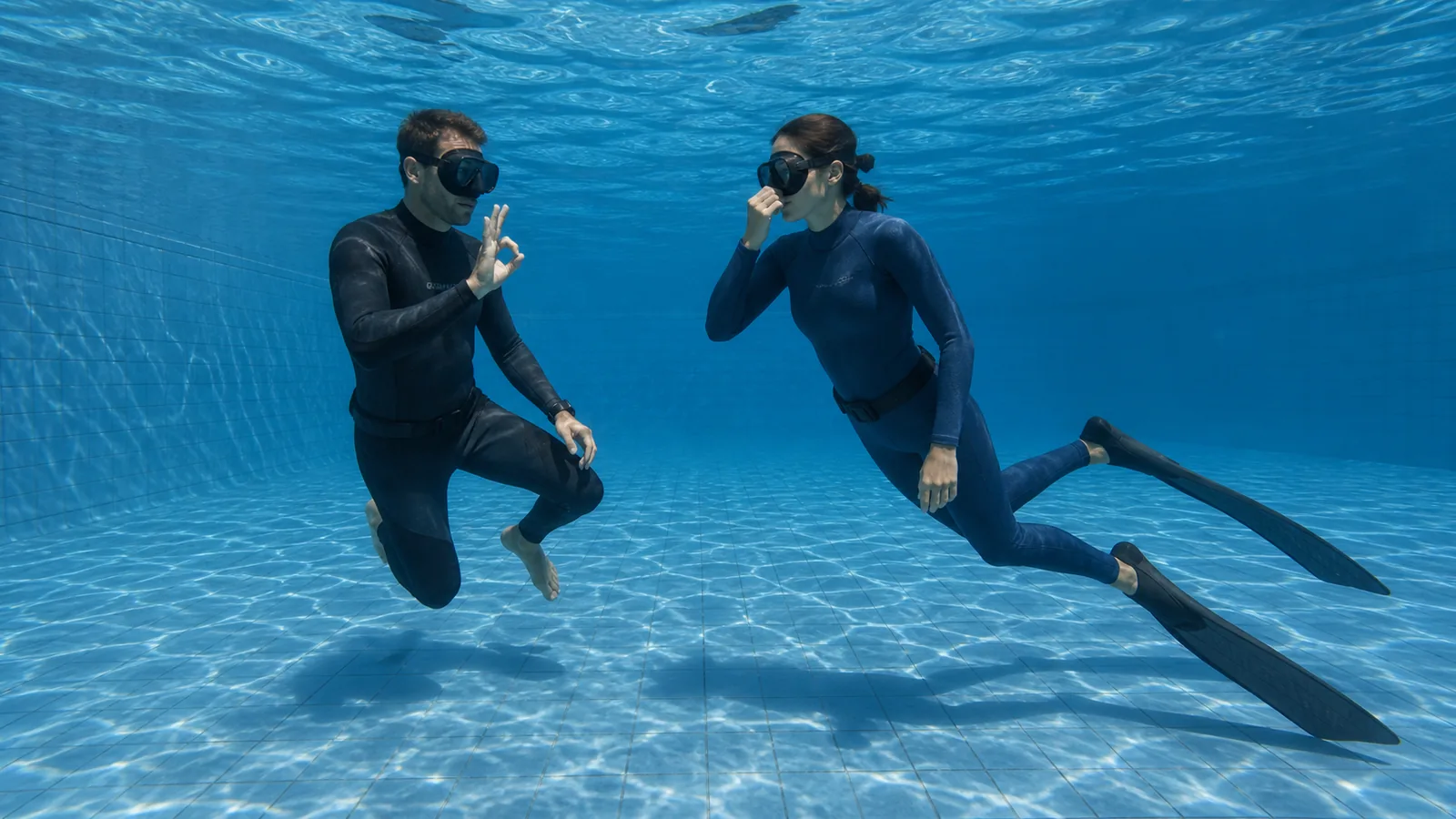
Freediving Course Guide: From Zero Experience to Your First Certification, Learn Safely and Systematically
First, the question you care about most: can you learn freediving on your own? My position is clear—breath-hold ability is influenced by individual physiology, training, and your condition at the time, but freediving involves risks such as hypoxia, equalization, and rescue, so systematic instruction is strongly recommended. You may be able to hold your breath for two minutes in a pool and feel proud, but when unfamiliar experiences such as a real descent, equalization, and diaphragm contractions rush in, without an instructor beside you, you may already be repeatedly teetering on the edge of danger. This is not alarmist talk; it is a lesson paid for by one blackout accident after another.
Why I Do Not Recommend Trying to Learn on Your Own
Many people think freediving is "just holding one breath and diving down." That idea is the most dangerous cognitive bias. The most fatal risk in freediving—hypoxic loss of consciousness (blackout)—can occur in the final ascent, near the surface, or even after surfacing, precisely where you feel you are already safe. It should be noted that blackout is essentially loss of consciousness caused by hypoxia, most commonly in the final ascent, near the surface, or after surfacing, but it can also occur during static apnea, dynamic apnea, and other dive phases; hyperventilation significantly increases the risk, but it is not a necessary condition for blackout to occur.
First, let us clarify the mechanism: hypoxic loss of consciousness (blackout) in freediving can occur in different dive profiles. In deep diving, during the final ascent or near the surface, as ambient pressure decreases and oxygen continues to be consumed during the breath-hold, blood oxygen may drop rapidly and the diver may "shut down" without obvious warning; during shallow-water or pool breath-holds, hyperventilation delays the urge to breathe and significantly increases the risk of hypoxic blackout. Blackout may occur without any obvious warning, or it may be preceded by LMC (loss of motor control), erratic movements, bubbles, or convulsions; once consciousness is lost, the diver may be unable to protect the airway and may drown quickly. In that moment, there is often none of the pain of choking or the panic of struggling. In formal competitions or regulated training, there are usually dedicated safety divers, buddies, and on-site rescue plans; but personal training or informal activities may not have these safeguards—alone, the consequences can be unthinkable.
Another pitfall that beginners easily fall into is hyperventilation. Many beginners see online advice to "take a few quick deep breaths before getting in" and follow it, but this excessively blows off carbon dioxide in the blood and suppresses the urge to breathe to a very low level, so hypoxic loss of consciousness may occur before a clear urge to breathe. By the time you want to ascend, it may be too late. Professional instruction teaches you to maintain normal, relaxed tidal breathing before descent, and finally, under the instructor's guidance, slowly take one full but not forced inhalation; hyperventilation, forced inhalation, and lung packing are prohibited, rather than just "holding" that breath.
This is exactly why systematic freediving instruction exists: it does not teach you "how to hold your breath longer," but how to understand and use your body within safe limits, minimizing risk rather than chasing unrealistic numbers.
What Freediving Instruction Actually Teaches
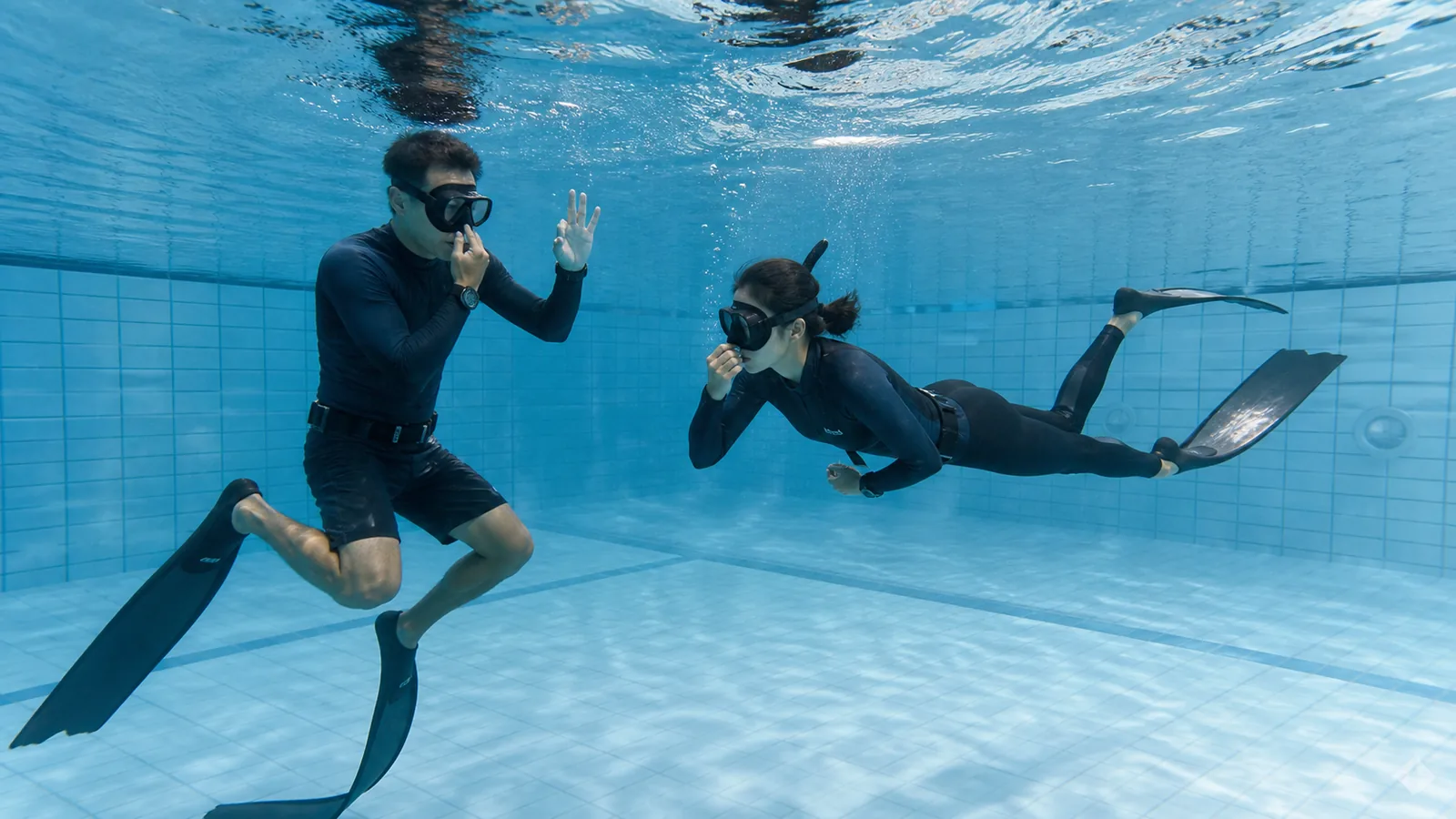 Pool training: student practices breath-hold and equalization under instructor supervision
A complete introductory course that includes open water generally progresses through three stages: theory, confined water, and open water (a few basic or pool-only courses may not include an open water stage).
Theory: Understanding Breathing and Your Body
The course spends a great deal of time on the breathing cycle, the mammalian dive reflex (MDR), the difference between static apnea (STA) and dynamic apnea (DYN), and most importantly the safety protocols—one-at-a-time diving, dedicated supervision, and buddy rescue principles (specific positioning, meet depth, and rescue procedures are subject to the certification agency, course, and on-site plan). You will know clearly: when to abandon a dive, what signals mean your body is warning you, where the buddy should be positioned, and how to recognize and respond to abnormalities. This is the foundation of the entire course, and it is the part self-study can never make up for. These exercises will help you gradually adapt to involuntary contractions of the diaphragm (commonly called "diaphragmatic contractions"), but remember: contractions are only a physiological signal during a breath-hold and do not mean you can continue to push—students should recognize their body's reactions under instructor guidance, and stop immediately if anything abnormal, loss of movement control, or discomfort occurs.
Confined Water (Pool): From "Holding Your Breath" to Breath-Hold
This is what most people assume is "simply practicing breath-holding." In fact, it is more about practicing relaxation: making diaphragmatic contractions no longer frighten you and turning equalization movements into muscle memory. Introductory courses commonly use long bi-fins, but specific equipment is subject to the course and program—monofins, bi-fins, and other fins may all be used in freediving; beginners should follow the instructor's choice and do not need to agonize from the start over "which one is the orthodox option." The pool stage is also the main setting for buddy rescue drills. In these exercises you will also learn: do not use diaphragmatic contractions, the urge to breathe, or subjective feelings to judge whether you can continue—any discomfort, abnormal movement, inability to equalize, or loss of technique control means you should immediately end the exercise.
Open Water: Common Training Content
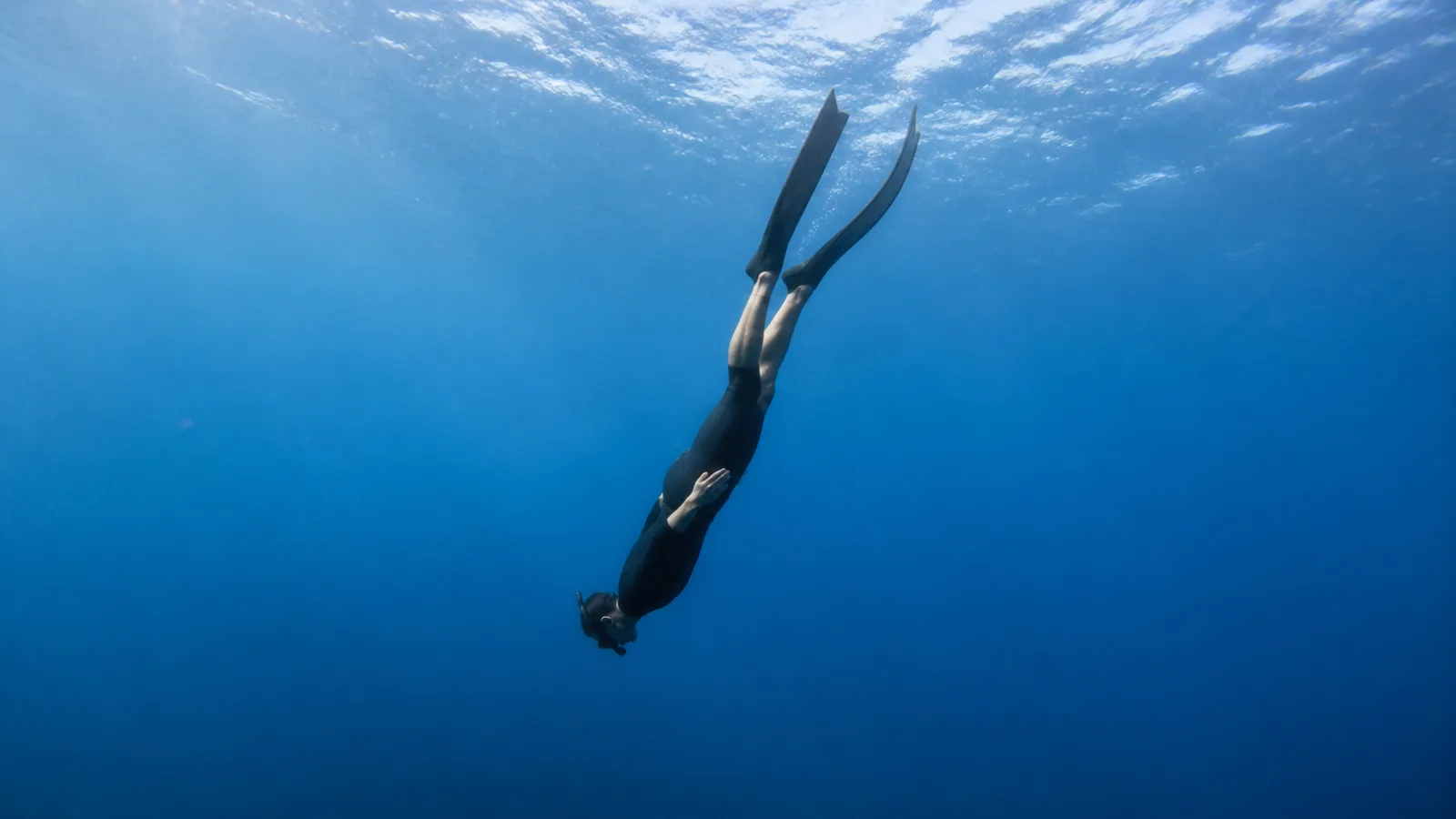 Open water: certified student makes a safe descent in long bi-fins
After getting in the water, the instructor may take you through exercises one by one: duck dive, constant weight with fins (CWT), equalization (Frenzel is one common method, but it must be done gently and promptly under instructor guidance; if pain occurs or you cannot equalize, stop the descent immediately), streamlined posture, and safe, efficient ascent and surface recovery. There are also specialties such as free immersion (Free Immersion, FIM, in which the diver descends and ascends along a vertical line using only the hands, without fins). However, which specific skills are practiced (whether CWT, FIM, and others are included) depends on the certification agency, course level, and instructor's arrangements; do not think of it as all courses teaching a fixed "set of five."
How to Choose a Freediving Course System
Common training systems on the market include AIDA, PADI, SSI, FII, and others. They are not absolutely superior or inferior to one another; the core differences lie in course structure, prerequisites, and completion methods. A special reminder: the specific course names, prerequisites, assessment criteria, and depth limits of each agency vary, and actual teaching quality also depends on the specific course, region, and instructor. Before booking, the current official standards of the relevant agency should be authoritative, and you should learn more about the reputation of the target dive shop; do not judge advantages solely by agency name or "positioning label."
| Comparison Item | AIDA | PADI | SSI | FII |
|---|---|---|---|---|
| Common Introductory Course | AIDA 2 | Freediver; also Basic Freediver (pool/confined water only) | Level 1; also Pool Freediving (pool only) | Level 1 |
| Course Environment | Theory + confined water + open water | Theory + confined water + open water; Basic version may be confined water only | Theory + confined water + open water; pool version may be pool only | Theory + confined water + open water |
| Age/Swimming Requirements | Subject to official standards | Subject to official standards | Subject to official standards | Subject to official standards |
| Maximum Depth | Subject to official standards | Subject to official standards | Subject to official standards | Subject to official standards |
| Rescue/First Aid Training | Subject to official standards | Subject to official standards | Subject to official standards | Subject to official standards |
⚠️ Note: The names, levels, and certification nature of each agency's "introductory" courses are not equivalent (for example, PADI Freediver and Basic Freediver, SSI Level 1 and Pool Freediving belong to different course/certification levels). The table above is only to help you build a framework for questions before booking; the specific course scope, depth, prerequisites, and certification type must be subject to the target agency's official standards.
When choosing which one, do not look only at the "brand." Look at these points: whether the course level and goals match your needs, whether the instructor holds a current valid teaching certification, whether the instructor-to-student ratio is reasonable, whether the instruction systematically covers safety protocols and rescue, and whether it includes the open water training you need. If you already have a scuba background and want to add a freediving course within the same ecosystem, the transition may be smoother, but scuba experience cannot replace the specialized skills and rescue training of freediving—ultimately it still depends on the target dive shop and the course itself. Whichever one you choose, it is advisable to book with a dive shop that has a good reputation and explains safety protocols clearly, rather than choosing based on low price—what you pay for instruction and accompanying safety is essentially buying safety redundancy and safeguards.
Questions You Must Clarify Before Booking
Choosing a course can easily go wrong. Asking the following questions before booking can significantly reduce the risk of a poor choice and incomplete safety protocols:
- Does the instructor hold a current, valid teaching certification? It is best to see the certificate rather than rely only on verbal assurances.
- What are the specific course level and depth limits? Is it a basic pool course, or does it include open water training? First be clear about which level you want.
- Is the buddy system mandatory, and is BO recognition and rescue taught systematically? If the curriculum does not cover the buddy system and blackout (hypoxic loss of consciousness, BO) concepts at all, walk away.
- Are there theory sessions and medical screening? A class that only gets in the water without teaching and just tells you to "try holding your breath" should not be called instruction.
How Long Does It Take from Zero to Certification?
Freediving does not have a uniform minimum number of hours like getting a driver's license; progress depends on the course level, the agency used, and the student's individual performance. Some agencies schedule AIDA 2 / PADI Freediver level courses as consecutive weekends or 2–4 day intensive courses, but that is only one arrangement. Whether you actually get certified depends on whether you can complete all requirements of the chosen course—some courses include minimum open water depth and swimming/water competency requirements, while pool-only courses (such as PADI Basic Freediver, SSI Pool Freediving) may not have open water depth requirements—specifics are subject to the agency's current standards. What truly makes the difference is regular, safe training after the course.
Safety and Emergency Response: These Are the Bottom Line
Freediving is a sport that requires taking your body's signals seriously. No matter whose course you take, the following points should be the bottom line, not optional:
- Never hold your breath in the water alone: Even in shallow pool water, you must be directly supervised by a buddy who is trained in buddy supervision and LMC/blackout rescue and is specifically responsible for that diver, at a distance where they can intervene promptly and protect the airway; agree in advance on hand signals, rescue roles, and recovery intervals.
- Dive one at a time with dedicated supervision: The buddy must not dive at the same time as the primary diver; whether a trained safety diver is needed to meet the diver in the final ascent or at a specified depth must follow the course, depth, and on-site plan, and untrained people must not dive to chase or rescue on their own.
- No hyperventilation: Do not breathe rapidly, deeply and quickly, or forcefully, and do not deliberately prolong exhalation to lower carbon dioxide; before descent, keep natural, relaxed, normal breathing.
- For equalization, follow "gentle, prompt, stop if painful": If you cannot equalize or feel pain, stop the descent immediately and ascend slightly; do not stay at the same depth and force equalization, and end the dive if necessary.
- Weighting must be conservative and assessed by the instructor: Weighting must be assessed by the instructor based on the actual equipment and water conditions; generally, ensure comfortable positive buoyancy at the surface even after exhaling, and achieve appropriate buoyancy at the relevant depth as required by the course; weights must be quick-release. Do not force a descent by adding weight.
- Follow proper recovery after surfacing: Remove the snorkel before descent; after surfacing, immediately perform recovery breathing as specified by the course, and promptly complete consciousness checks, hand signals, and verbal signals (such as "OK") as required by your agency; only after the buddy confirms you are stable and the required surface interval is completed may you begin the next descent (specific surface interval requirements are subject to your agency's protocol).
- Stop training immediately if anything abnormal occurs: After LMC or blackout, immediately end the day's in-water training and get out of the water for observation; do not re-enter the water for at least 24 hours; if there is water aspiration, persistent symptoms, or abnormal consciousness, seek medical evaluation as soon as possible and resume training only under medical advice.
- Watch for decompression sickness and barotrauma: Decompression sickness is less common in freediving, but repeated deep dives in a short period and extreme-depth training increase the related risk; lung barotrauma and other dive-related pressure injuries also require vigilance. Do not do open water freediving on the same day after scuba diving; for other dive combinations and intervals, follow the professional advice of your certification agency and diving medicine specialists.
- Health screening and medical clearance are the bottom line: Cardiovascular, respiratory, ear, nose, throat, neurological, and other system problems can all affect fitness for training; complete a health screening before booking, obtain medical clearance if necessary, and inform the instructor truthfully.
Abnormalities and Emergency Management: What to Do When Problems Arise
In-water rescue and onshore first aid are two different things, and you should ask clearly about both when booking. Once a diver shows LMC or blackout, the first thing to do is not determine the cause, but follow trained procedures: after ensuring their own safety, rescuers bring the patient out of the water, call the on-site emergency system, and assess for normal breathing; if the patient has no normal breathing after leaving the water, trained personnel should immediately perform CPR including rescue breaths according to the latest local emergency procedures (for cardiac arrest caused by drowning, rescue breaths should be given as early as possible; do not wait for an AED or delay CPR to retrieve an AED; once an AED arrives, use it as soon as prompted, moving the person out of the water and drying the chest before use). If the patient has normal breathing but is unconscious, keep the airway open, place them in the recovery position, and monitor continuously. Oxygen administration should only be performed by personnel trained to do so. Even if the person appears to have recovered, they should receive a medical evaluation rather than just being allowed to go back in the water.
It should be noted that not all introductory freediving courses automatically include full CPR/first aid certification—when booking, confirm: whether the course includes buddy supervision, LMC/blackout recognition, and in-water rescue; whether CPR, first aid, and oxygen administration training are included in the course must be verified separately, and relevant certificates may need to be obtained separately if necessary.
Frequently Asked Questions (FAQ)
Q: Can freediving be completely self-taught?
A: Strongly not recommended. Blackout, hyperventilation, and buddy rescue are life-and-death topics that self-study is most likely to miss. Proper training and a buddy can minimize risk, but no training can reduce risk to zero—so systematic instruction is even more important as a safeguard.
Q: Do I have to know how to swim to learn?
A: You do not need to be a competitive swimmer, but you must meet the minimum requirements of the target course for swimming, treading water, and open water comfort (for example, SSI, FII, and others have clear water competency standards). Be sure to check the specific prerequisites of your chosen course when booking; if you easily panic in the water or cannot swim independently, you should not begin breath-hold training.
Q: Will scuba equipment be used in freediving instruction?
A: Students usually do not use scuba equipment as breathing equipment; freediving courses commonly use fins, masks, snorkels, and other freediving gear. However, in some open water courses or safety support, the instructor or safety diver may use scuba configurations. Specific equipment is subject to the course and program arrangements.
Q: Can older people or those with poor fitness learn?
A: Many experienced freedivers came to the sport after age forty, and freediving values technique as well as relaxation. But whether you can learn depends on multiple factors such as your health, age, water skills, and fitness—first complete a health screening, obtain medical clearance if necessary, check the course requirements for age and swimming ability, then follow the instructor and progress gradually.
Q: What equipment should I use to start practicing after the course?
A: Do not rush to buy a full set. For fins, "entry-level" depends more on stiffness, fit, and instructor advice, not on whether a certain material is mandatory for beginners; wait until your posture is stable and your level improves before considering higher-end options such as carbon fiber, to avoid wasting your budget on unsuitable equipment at the start.
Final Thoughts
What freediving instruction gives you is far more than a certification. It teaches you how to communicate with your body, how to stay calm under pressure, and how to turn the habit of "wanting to win" into "safety first." This process takes patience, but there is only one starting point—choose a reliable course, find a responsible instructor, and honestly learn from the safety principles in the first lesson. Before starting the course, you can practice relaxation and normal breathing at home, and you can use visualization training to familiarize yourself with the process in advance—but do not practice breath-holds alone in the water, and do not perform extreme breath-holds. Formal introductory instruction and new skill training must be guided by a qualified instructor; practice after training must also be conducted with a buddy who is trained in the relevant rescue and specifically responsible for supervision.
This article is for general information reference only and does not constitute any instructional advice or exercise prescription. Freediving has clear safety risks; the specific standards of each course should be subject to the official publications of the corresponding certification agency. Be sure to train under a certified instructor and with a full buddy system. If you have health concerns, consult a doctor first.