Semporna Freediving Guide | Dive Sites, Seasons, Costs, and Itineraries
 Semporna Freediving Guide | Dive Sites, Seasons, Costs, and Itineraries
Let’s answer your main question first: is Semporna worth a trip specifically for freediving? Yes, but set your expectations correctly first—Semporna’s draw is visibility and fish schools, not “the easiest freediving.” Some dive sites here have strong currents, and boat rides are not short. It suits people who already have basic training and want to practice skills or take photos/videos in better water conditions.
This article explains clearly: which islands to visit, what season to go, how to plan your itinerary and budget, and a few common pitfalls.
Where Semporna Is and How to Get There
Semporna is in the southeastern corner of Sabah, Malaysia, and is the gateway town for nearby islands. For most itineraries, the base is not Semporna town but a resort on an outer island.
Two common routes:
- Fly to Tawau (TWU) + drive: Fly from Kuala Lumpur or Kota Kinabalu to Tawau, then take a car for about 1–1.5 hours to Semporna town, then a speedboat to the outer islands. This is the most commonly used route.
- Transit via Kota Kinabalu (BKI): Fly from China to Kota Kinabalu, then take a domestic Malaysian flight to Tawau. This suits itineraries that also want to visit Sabah.
Visa and entry: Eligible holders of Chinese ordinary or service passports entering Malaysia for tourism and other specified purposes may be allowed visa-free stay under current policy; however, visa-free entry does not apply to all passport types or all purposes of visit. Requirements for passport validity, the Malaysia Digital Arrival Card (MDAC), and length of stay are subject to the latest announcements from the Malaysian Immigration Department and Malaysian embassies and consulates. Be sure to confirm before booking tickets.
Main Dive Sites
The depths in the table below are dive site topography references, not personal diving targets or course limits. The actual depth you descend to must follow your certification level, training level, instructor’s plan, buddy setup, and the day’s sea conditions.
| Dive site | Features | Topography/depth reference | Suitable for |
|---|---|---|---|
| Mabul | Macro photography destination, sandy bottom, convenient shore diving; base for many freediving trips | 5–25 m | Those with basic training to practice skills and take photos/videos |
| Kapalai | Sandbar, good visibility, calm surface | 5–20 m | Photos/videos and calm-water practice |
| Sipadan | Internationally known dive site, walls, schools of barracuda, schools of jacks | 10–40 m | Mainly scuba diving; permits are strictly controlled |
| Mataking | Sandbar and coral reefs, good visibility | 10–30 m | Freedivers with basic training |
| Sibuan | Shallow coral, white sand, good light | 3–15 m | Beginners, snorkeling, photos/videos |
| Bohey Dulang | Volcanic crater island; hike to the summit for views over the lagoon | Mainly on land | Those who want landscape photos (hiking requires a park permit) |
| Mantabuan | Good coral coverage, fewer visitors | 5–20 m | Freedivers with basic training |
About Sipadan, this must be clear: It is a regulated marine protected area, and you must apply in advance through a registered operator; the specific daily quota, permit fee, number of dives allowed, and whether freediving is permitted are all subject to the current regulations of Sabah Parks and the operator—figures circulating online vary, so do not rely on them as a basis, and do not assume it can be included in your itinerary.
Mabul and Kapalai are more realistic choices for freediving: shallow water, sandy bottoms, and many scenes suitable for photos/videos.
Seasons and Sea Conditions
| Time | Sea conditions | Notes |
|---|---|---|
| March–October | Dry season; sea conditions are relatively stable | Prime season, good visibility |
| November–February of the following year | Rainy season; more wind, waves, and rain | Boat trips may be cancelled at short notice; keep your itinerary flexible. |
Water temperature is around 26–30℃ year-round. Most people can wear a 1.5–3mm wetsuit; if you get cold easily, a 3mm is a safer choice.
Even in the dry season, you may encounter swell and currents, and not all currents are horizontal. Strong surface currents or downcurrents can occur around Mabul and Mataking.
If you encounter a strong current or downcurrent, the correct action is to end the dive immediately, follow the contingency plan from the captain, instructor, and local dive site briefing, stay in contact with your buddy, and exit safely; do not fight the current, and do not treat “reef-hugging ascent” as a fixed escape technique—hugging the reef can create risks of collision, cuts, or entanglement. Check the day’s sea condition forecast before departure, and do not force a boat trip just because “you’re already here.”
Itinerary and Accommodation
- Semporna town: cheaper accommodation and convenient dining, but dive sites are about 40 minutes to 1.5 hours away by boat;
- Mabul Island resorts: dive sites are right outside, suitable for people who want to spend their time in the water, but prices are higher;
- Kapalai water bungalows: mainly a resort experience, often bundled with diving packages.
A common 5–6 day rhythm:
- Day 1: Arrive in Tawau, transfer by car to Semporna, stay in town or go directly to an island
- Days 2–3: Training/photos/videos around Mabul, acclimating to water conditions
- Day 4: Boat trip to Kapalai or Mataking (full-day trip; book in advance)
- Day 5: Shallow-water photos/videos at Sibuan + buffer/return trip
- Day 6: Keep as a buffer day (to make up for trips cancelled due to weather)
When planning your itinerary, don’t forget two things:
- Repeated deep dives with too-short intervals accumulate nitrogen exposure and may increase the risk of decompression sickness. Space them out as much as possible, limit the number of dives per day, and don’t pack every day full;
- After scuba diving on the same day, do not go on to do open-water freediving. Combining the two significantly increases decompression risk; follow your agency’s rules and your instructor’s advice for specific intervals.
Outer-island boat schedules and boat trip slots must be booked in advance, and they are especially tight in peak season—the most common pitfall is “deciding to add an island only after arriving in Semporna.”
Approximate Cost Range
The following are approximate market ranges, for expectation reference only, not a quote. Local prices are quoted in Malaysian ringgit (MYR); RMB values are estimates based on exchange rates. When booking, be sure to ask clearly whether each item includes equipment, meals, taxes, and permit fees.
| Item | Approximate range |
|---|---|
| Introductory course (if booked locally) | About MYR 1,800–2,800 |
| One-day freediving boat trip (including boat, dive guide, equipment) | About MYR 200–400/day |
| Mabul Island resort (meals included; diving packages common) | About MYR 350–800/night |
| Mid-range accommodation in Semporna town | About MYR 120–300/night |
| Transport from Tawau Airport to Semporna | About MYR 60–120/one way (priced per person or per vehicle; subject to local practice) |
| Airfare | Varies widely depending on departure city and season |
Overall, Semporna’s value for money is mainly in outer-island accommodation packages: meals, accommodation, and diving are bundled, which is more economical than booking separately; but if you stay only in town and take a boat every day, both time and money costs will rise.
Safety and Environment: Rules That Must Not Be Broken
- One up, one down, performed by a trained buddy. Any breath-hold in the water must have a buddy trained in freediving rescue present and specifically monitoring; do not begin the next dive until the buddy has completed recovery breathing and their condition has been confirmed normal. Perform recovery breathing according to your agency’s standards; do not treat “counting 30 seconds” as the only criterion.
- Hyperventilation is strictly prohibited. Rapid deep breathing lowers carbon dioxide and delays the urge to breathe, allowing shallow-water blackout (BO) to occur before obvious discomfort—do not do so-called “lung-clearing breaths”; only do the relaxation breathing taught by your instructor.
- Start equalizing from the beginning of the descent. Equalize frequently and gently; if you cannot equalize, stop the descent immediately and return to the surface. Never force it.
- Stop for the day if problems occur. If LMC, dizziness, persistent tinnitus, or inability to equalize occurs, stop diving immediately for the day.
- For blackout or suspected water aspiration, treat as a medical emergency. Immediately perform trained surface rescue, protect the airway, call emergency services, and seek medical care; even if the person appears to recover, they must never continue diving on their own—after a blackout, they should stay out of the water for at least 24 hours and receive a medical evaluation.
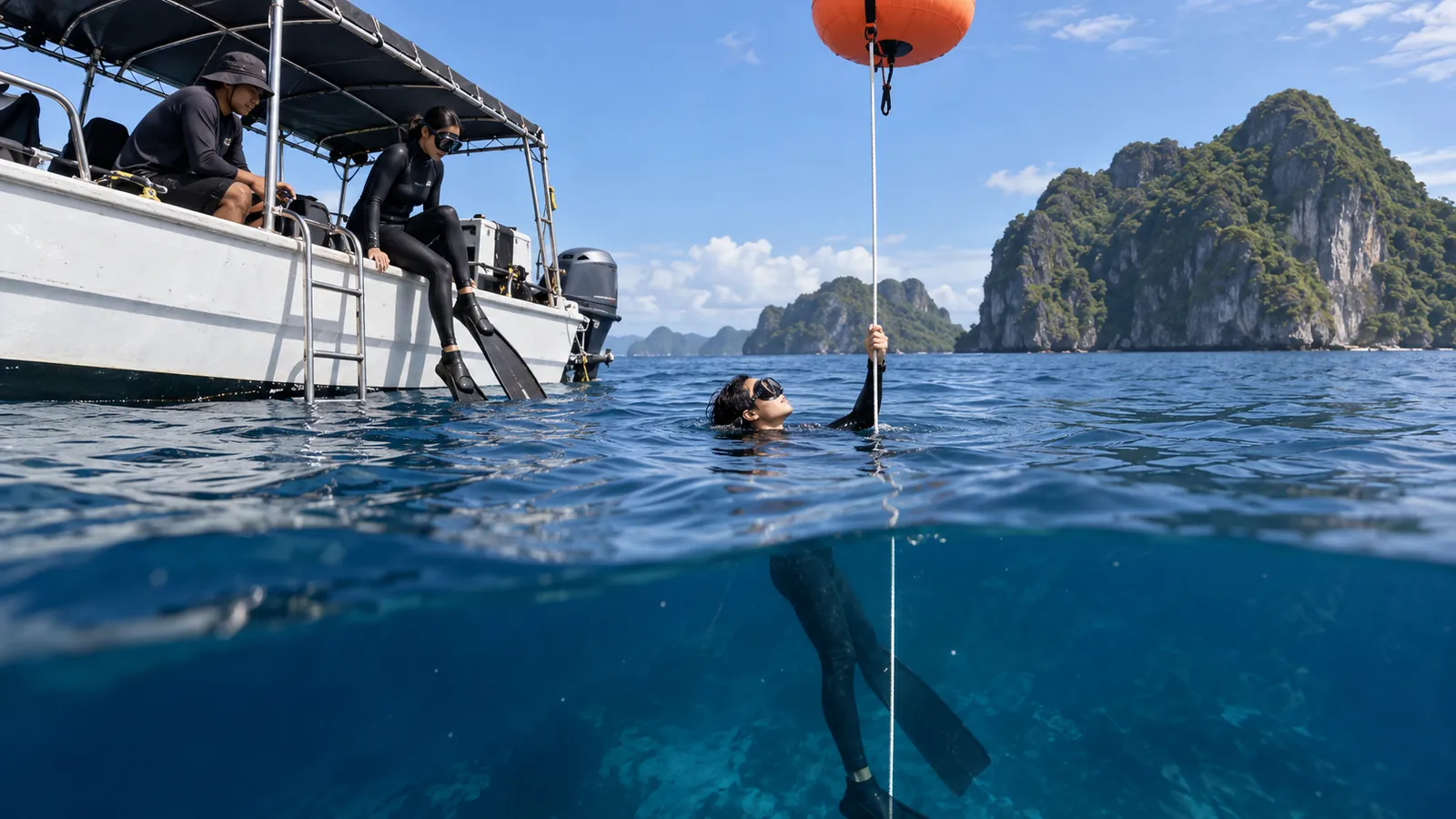
- Ascend with a surface buoy or float marker. Semporna has dense boat traffic; without a buoy, boat crews can easily overlook you. Do not dive near shipping lanes or docks.
- Watch out for sea urchins, jellyfish, and coral. Do not step on reef flats or grab things from coral crevices with bare hands; wearing a wetsuit or stinger suit can reduce the chance of cuts. Do not dig deep or squeeze sea urchin spines; deep punctures, joint punctures, retained spines, or persistent pain require medical attention. Avoid rubbing jellyfish stings; first follow local first-aid guidance, and if systemic symptoms such as difficulty breathing, vomiting, or altered consciousness occur, seek emergency care immediately.
- Do not chase sea turtles or fish schools. This is explicitly prohibited in protected areas and may result in fines.
- Prioritize physical sun protection. Wear sun-protective clothing, stinger suits, and hoods for cover; if you use sunscreen, choose it according to local protected-area rules and the ingredient list—“reef-safe” is not a unified regulatory standard, and the label alone cannot determine whether a product is truly reef-friendly.
Frequently Asked Questions (FAQ)
Q: Is Semporna suitable for learning freediving with no prior experience? A: Yes, but it depends on the specific arrangement. Mabul’s shallow, sandy-bottom areas are relatively suitable for beginner training; if you book a site with strong currents or greater depth, the experience will be much worse. When booking, ask clearly which area the course takes place in and whether the instructor is certified.
Q: Can you freedive at Sipadan? A: Sipadan requires an application through a registered operator. The daily quota, permit fee, and whether freediving is permitted are subject to the current regulations of Sabah Parks and the operator, and the area is mainly for scuba diving. Do not treat it as a freediving site you can visit by default.
Q: Which month is the least suitable to visit? A: November to February of the following year is the rainy season, with a higher chance of wind, waves, and rain, and boat trips may be cancelled at short notice. If you can choose your dates, prioritize March–October.
Q: Do I need to bring my own equipment? A: It is recommended to bring your own mask (fit is most important). Fins, wetsuits, and weights can usually be rented from most dive shops or resorts; consider buying them if you practice long-term.
Q: Can I go if I don’t speak English? A: Semporna has quite a few Chinese-speaking dive shops and instructors, but boat crews, drivers, and resort staff mostly use English or Malay, so basic English communication is still helpful.
This article is for itinerary reference only and does not constitute travel or course advice. Flights, visas, entry requirements, boat schedules, quotas, prices, and sea conditions may all change; please rely on the latest information from official sources and local operators. Freediving is a high-risk activity; learn under a certified instructor and always follow the buddy system.