Freediving Safety Guide | From Blackout to Buddy, the Bottom Lines You Must Know
 Freediving safety guide
First, the question you care about most: is freediving safe? The honest answer is that with proper training, a buddy system and self-discipline, freediving can be very safe — but if any one part of that slips, it can turn deadly in an instant. This article is not meant to sell anxiety. It sets out every key point directly related to freediving safety, so you know where the red lines and the bottom lines are before you get in the water.
The biggest risk in freediving is not "running out of breath"
Many beginners think the thing to fear most in freediving is "holding your breath to the limit and not being able to breathe". In fact, in freediving deaths and injuries, the most common cause is hypoxic loss of consciousness (Blackout, BO) — it is not "not being able to hold it", but the brain shutting down with no warning, followed by drowning.
What makes BO most dangerous is that it has no obvious signal of distress. There is no struggle from inhaling water, no fear of suffocation — just a sudden blackout. If your buddy is not nearby at that moment, does not spot it in time and does not protect your airway, drowning is only minutes away. This also explains why most freediving accident victims are not "people who cannot swim" but experienced divers.
The buddy system: half your safety rests with your partner
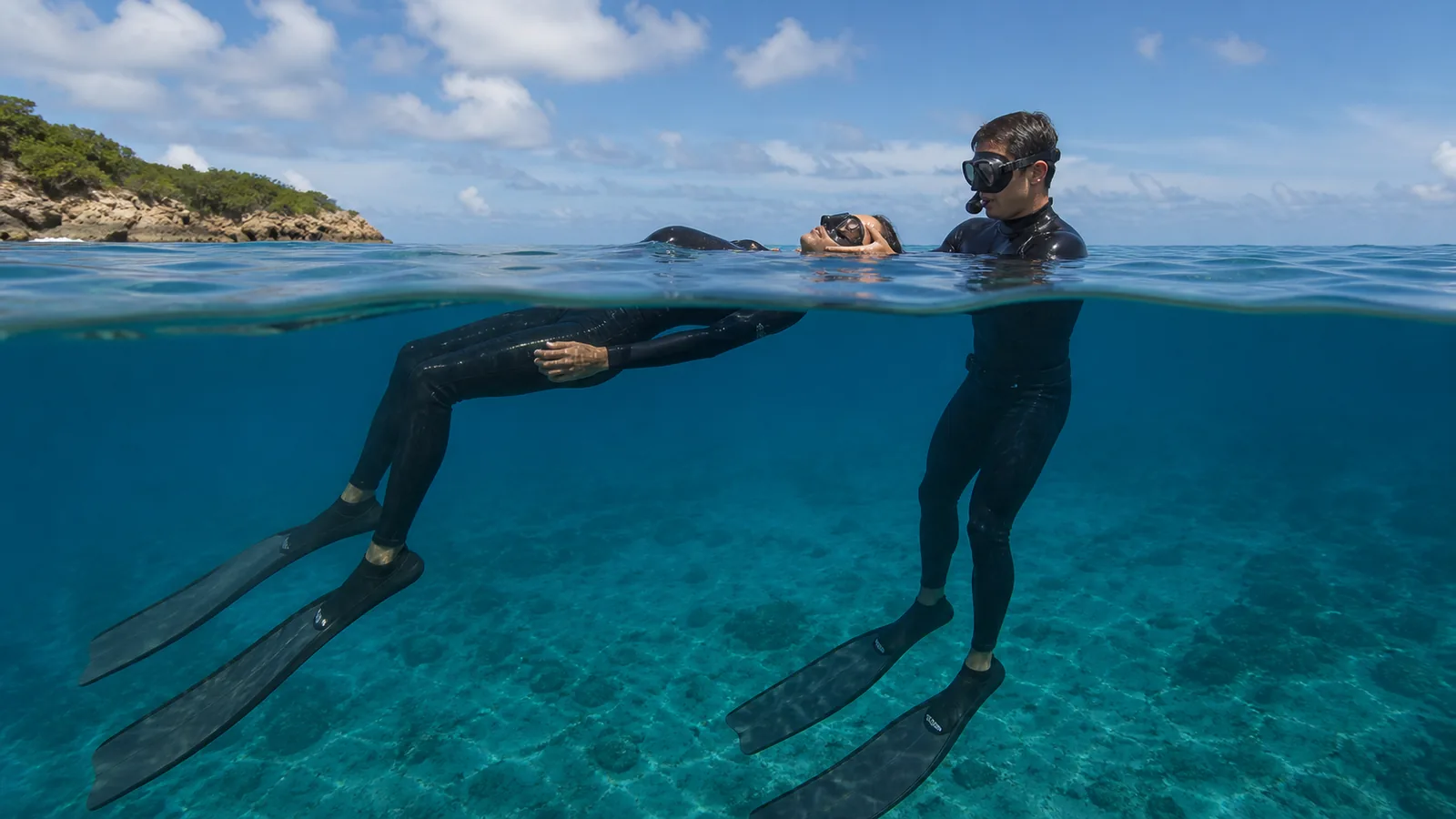
Never dive alone in freediving. This is an iron rule. No matter how good you are, no matter how shallow the water is (even a pool), a trained buddy must be watching over you.
What a buddy is responsible for:
- One buddy per diver: a buddy watches one diver only — no checking your phone, no covering someone else at the same time.
- Within a distance where the airway can be protected: stand near your descent point, ready to hold you the moment you surface.
- Watch your state of mind after surfacing: you remove your snorkel, do recovery breathing and give the "OK" sign — the buddy's watch only ends once they confirm you are stable.
- The meeting depth is set by the course and the on-site plan: whether a buddy needs to descend to meet you in the final part of the ascent depends on depth, environment and the course outline; not every dive requires a buddy to follow you down.
Hyperventilation: you think you are "storing oxygen", but you are creating risk
Hyperventilation is the most commonly misunderstood and misused pre-dive preparation in freediving. Many people take a few fast deep breaths before getting in, thinking this "stores more oxygen" — the opposite is true.
Hyperventilation does not significantly increase blood oxygen, but it greatly lowers the carbon dioxide level in the blood. Carbon dioxide is your body's signal that it is "time to breathe" — when it is pushed down, the urge to breathe is delayed, and the brain may already be short of oxygen while you still feel "I can hold it". This is why hyperventilation is one of the most common triggers of BO.
The correct approach: before the descent, keep normal, relaxed tidal breathing, then finish with one natural, comfortable inhale as your instructor directs — a small amount is enough. Fast breathing, deep rapid breathing, forced inhalation and lung packing are not allowed.
Ear pressure and barotrauma: do not force it
When you cannot equalize, stop the descent immediately and ascend a little. Do not stay at the same depth and force it. Forcing equalization can cause eardrum perforation and middle-ear barotrauma, which ends the dive. Common equalization methods include Frenzel and Valsalva; which one you use and how you practise it should be guided by an instructor.
Lung barotrauma (pulmonary barotrauma) also needs attention — it usually happens when you hold your breath on the ascent, or when the lungs re-expand rapidly after being compressed. Lung barotrauma is less common in freediving than in scuba, but extreme-depth training and repeated deep dives increase the risk.
Weighting: better too light than too heavy
Weights are not there to help you descend; they offset the positive buoyancy of your wetsuit and your body. Your weighting must be assessed by an instructor based on your actual equipment and the dive area. The usual principle is: stay comfortably positively buoyant at the surface even after exhaling, and reach the right buoyancy at the relevant depth as required by your course. The weighting system must be quick-release — if a BO occurs, being able to drop weight quickly is a key design feature for reducing drowning risk.
Overweighting is one of the most dangerous mistakes — if you are too heavy, you already sink at the surface and cannot float on your own after a blackout, so your buddy has to tow you up — many times harder than a normal rescue.
Do not freedive after scuba diving
This is an iron safety rule many people do not know: do not do open-water freediving on the same day as scuba diving. Scuba diving leaves residual nitrogen in the body that can form bubbles; if you then do deep freediving with fast ascents, it may trigger decompression sickness. The intervals between different dive combinations should follow the guidance of your certification agency and dive medicine professionals.
Emergency response: what to do when you spot a problem
As soon as a diver shows LMC (loss of motor control — uncontrolled movement, twitching, no normal response to hand signals) or blackout:
- Once the rescuer has ensured their own safety, bring the casualty out of the water and call the on-site emergency system.
- Assess breathing: if there is no normal breathing, a trained person must start CPR including rescue breaths immediately, following the latest local emergency protocols (for drowning, rescue breaths should be given as early as possible; do not delay CPR to fetch an AED; use the AED as soon as it arrives, following its prompts).
- If there is normal breathing but the person is unconscious, keep the airway open, place them in the recovery position and keep monitoring.
- Even if the casualty appears to recover, they should receive a medical assessment.
- After an LMC or blackout, end all in-water training for the day immediately; do not get back in the water for at least 24 hours.
Freediving safety: the bottom-line checklist
| Item | Bottom line |
|---|---|
| Buddy | Never dive alone; one buddy per diver; trained in rescue |
| Hyperventilation | Not allowed; keep normal breathing before the descent |
| Ear pressure | Stop at pain, ascend a little, do not force it |
| Weighting | Assessed by an instructor; floats comfortably at the surface after exhaling; quick-release |
| Freediving after scuba | Do not combine on the same day |
| Blackout/LMC | Get out of the water immediately → call emergency services → CPR (with rescue breaths) → AED → medical care |
| Health screening | Consult a doctor first for cardiovascular, respiratory, ear, nose or throat problems |
| Training | Only under a certified instructor; practise under the supervision of a qualified buddy |
Freediving is a conversation with your own body — not a fight with it. Safety is not something to think about "once I get good"; it is something built into muscle memory from the very first course. When safety becomes a habit, freediving can truly become a lifelong pleasure.
This article is for general information only and does not constitute medical or instructional advice. Freediving is a high-risk activity; train only under the guidance of a certified instructor and with a qualified buddy watching over you. If you have any health concerns, consult a doctor first.