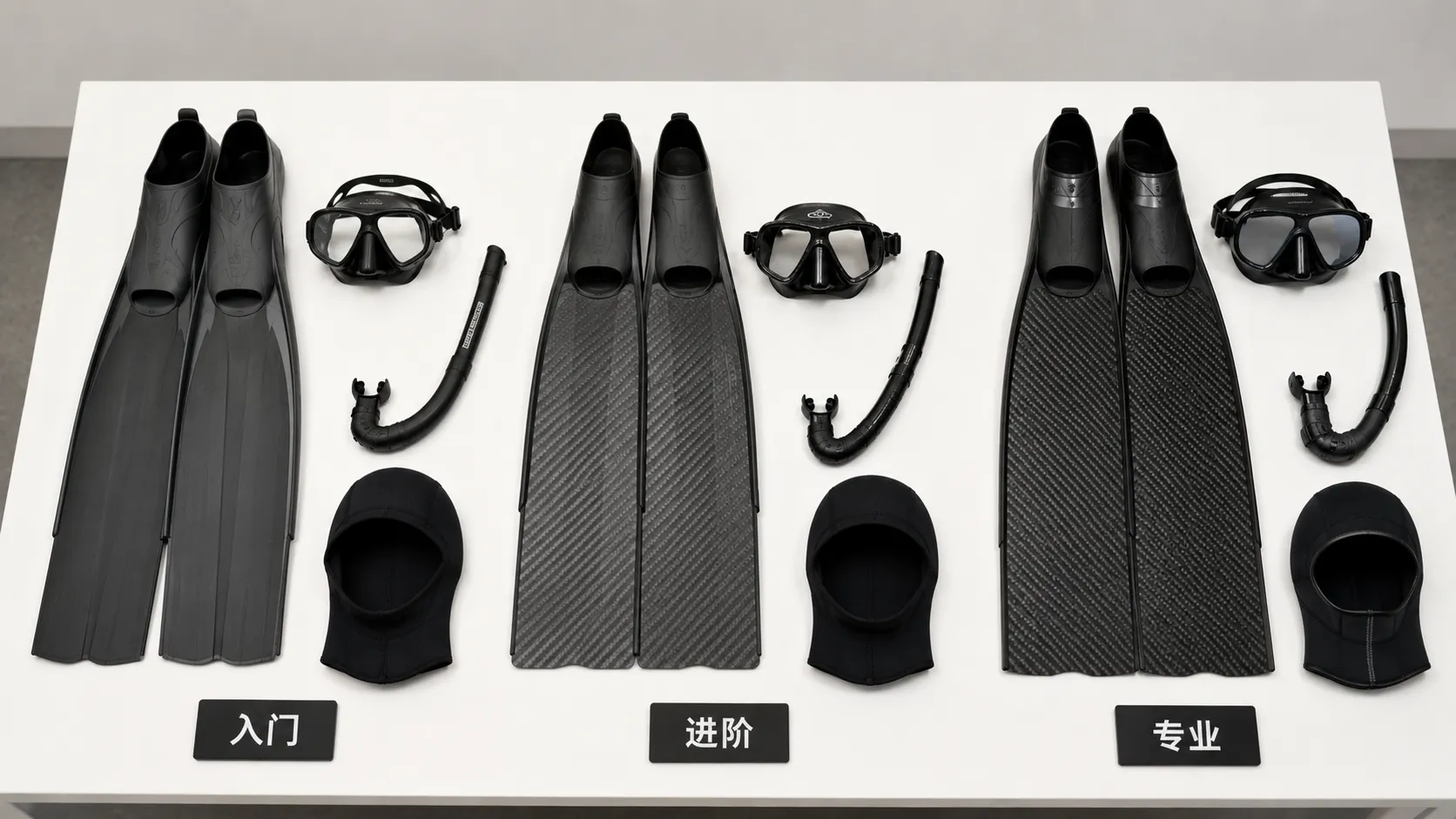
For a beginner's first set of gear, ¥3000-5000 can get you a very good option.
You don't need to go straight for carbon-fiber fins; at your current level, you won't be able to make use of their value. I've seen too many beginners buy a high-end set and end up diving less deep than I did with rented plastic fins.
Gear is a tool, not a talisman. Once your skills are there, ordinary gear can also reach depth.
Beginner gear purchase order (by importance)
1️⃣ Low-volume mask (must buy, ¥300-800)
The mask is the only piece of gear that "must fit your face." A rented mask won't fit your face shape exactly.
How to choose:
Prioritize a low-volume design; the smaller the volume, the easier it is to equalize.
But note: smaller volume is not always better—it must fit your face to be effective. On a large face, an overly small mask's skirt cannot seal completely, so the effective volume is actually larger and it tends to leak.
You must try it on in person: without a snorkel, inhale through your nose only; if the mask sticks to your face and does not fall off, it fits.
Lens size affects field of view, but do not sacrifice fit for field of view.
For lens material, prefer tempered glass; resin lenses scratch easily and may have edge distortion.
Tip: Before using a new mask, pretreat the inside of the lens with toothpaste to prevent fogging.
Recommended purchase price: ¥300-800. This is the piece of gear most worth investing in as a beginner.
2️⃣ Snorkel (must buy, ¥100-300)
We recommend a semi-dry or dry snorkel, with a body that has some support but a flexible top. A completely rigid snorkel is inconvenient to put on and store; an overly soft body can move around underwater and affect relaxation and breathing rhythm.
3️⃣ Long fins (core gear, ¥800-10000+)
Fins have the biggest price range among freediving gear; materials range from plastic to carbon fiber, with prices differing by 5-10 times.
Material | Price range | Features | Suitable for |
|---|---|---|---|
Plastic/thermoplastic | ¥800-1500 | Durable, moderate flex, moderate weight | Beginners |
Fiberglass | ¥3000-5000 | Good flex, light, medium energy transfer efficiency | Intermediate divers |
Carbon fiber | ¥5000-10000+ | Very light, fast rebound, highest energy transfer efficiency | Experienced depth divers |
Material note: Carbon fiber has the fastest rebound and highest energy transfer efficiency and is the first choice for professionals, but the material is brittle and vulnerable to impacts; fiberglass is tougher, more durable, and moderately priced, making it a cost-effective choice.
My advice: Rent for a while before deciding whether to buy and which type to buy. When you first start training, you cannot feel the difference between fins of different materials. If you must buy, plastic or entry-level fiberglass is enough until you finish your Level 2 course. Once you are above Level 2, you will naturally have your own preferences.
4️⃣ Wetsuit (¥800-2000)
Open water temperature is usually lower than body temperature; a wetsuit reduces heat loss and extends underwater time.
Thickness guide:
Tropical waters (water temp 26℃+): 1.5-2mm, or even no wetsuit
Subtropical/temperate in summer (water temp 22-26℃): 2-3mm
Temperate (water temp 18-22℃): 3-5mm
Freediving wetsuit vs surfing wetsuit:
Freediving wetsuits usually use a smooth-skin (Glide Skin) outer fabric, with very low drag, and are more form-fitting and softer, with a focus on streamlining
Surfing wetsuits use nylon fabric that is more abrasion-resistant, but they have higher drag and somewhat less comfort and range of motion
You can dive in an ordinary surfing wetsuit, but if you plan to keep freediving long term, it is advisable to go straight to a freediving-specific model.
5️⃣ Weight belt (¥200-500)
The weight belt balances the buoyancy of the wetsuit. A quick-release function is required—if there is a problem, you can quickly drop the weights and ascend.
Material advice: Prefer a rubber weight belt; it is more slip-resistant than nylon webbing and less likely to shift during a dive. It is not recommended to use an ordinary belt instead.
6️⃣ Dive computer (later investment, ¥2000-5000)
A freediving computer differs from an ordinary watch in that it can record dive depth, time, and surface rest time; some models also have dive planning and safety alert functions.
Common brands and reference prices:
Cressi Nepto: ¥2000-3000, freediving-specific, good value
Garmin Descent G2: ¥4000+, comprehensive functions
Garmin Descent MK series: ¥6000-10000+, professional grade
Suunto D series: ¥3000-6000
Shearwater: ¥5000-10000+, a benchmark in technical diving
Beginners do not need to buy one right away. Consider it once you are sure you will keep freediving long term.
Beginner gear setup summary
Gear | Suggested price | Priority | Notes |
|---|---|---|---|
Mask | ¥300-800 | ★★★★★ | Must fit face; try on in a physical store |
Snorkel | ¥100-300 | ★★★★★ | Semi-dry/dry, body has support |
Fins | ¥800-1500 (entry-level) | ★★★★ | Rent before buying; entry-level plastic is enough |
Wetsuit | ¥800-2000 | ★★★ | Choose thickness based on water temperature |
Weight belt | ¥200-500 | ★★★ | Must have a quick-release buckle |
Computer | ¥2000-3000 (entry-level) | ★★ | Consider later |
Complete beginner budget: ¥3000-5000 (mask + snorkel + entry-level plastic fins + basic wetsuit + weight belt) to put together a set that will last for years.