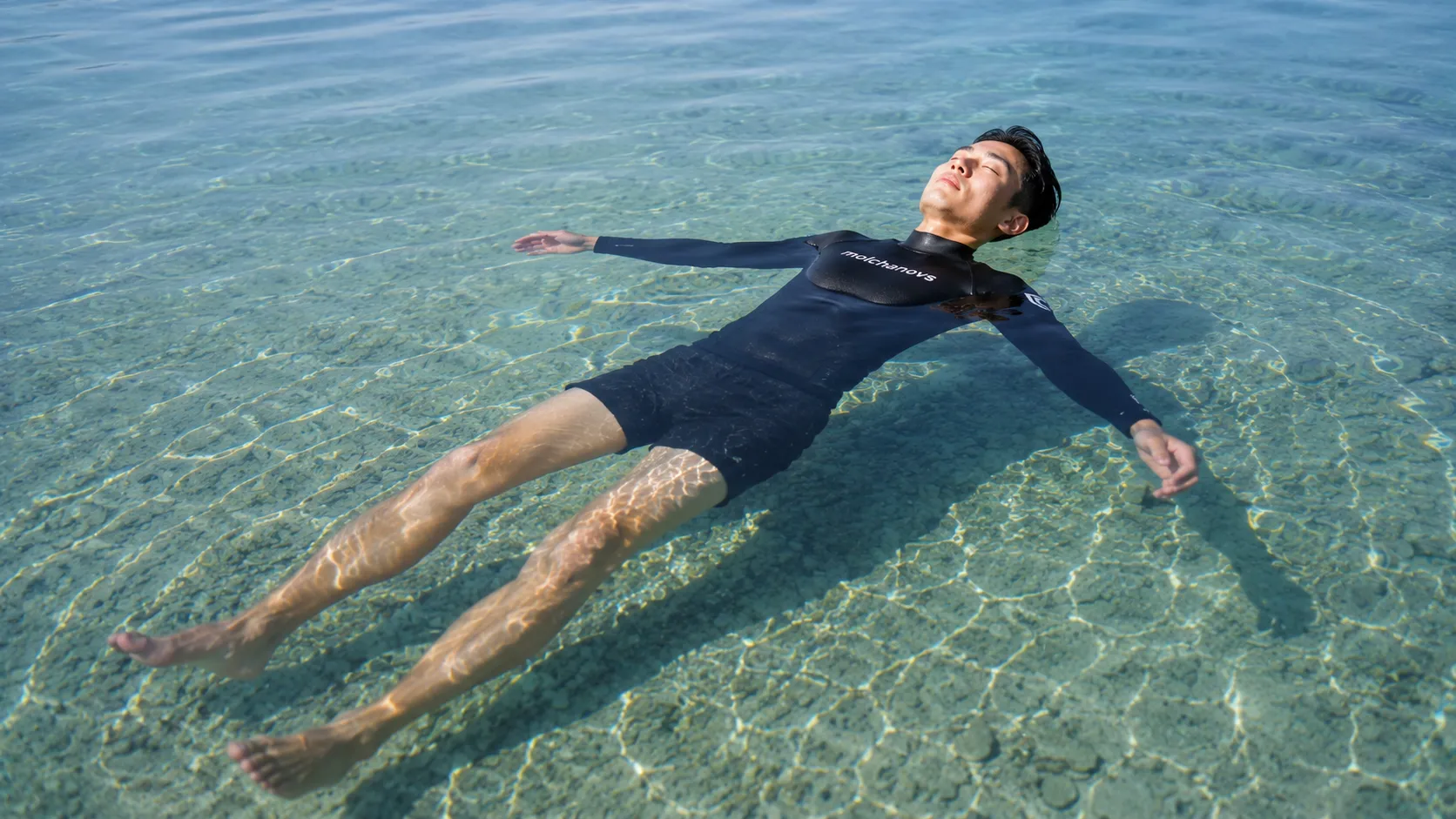
First, take a test: what is your breath-hold time?
You can try it right now. Find a bed or sofa, lie flat, take three deep breaths, inhale fully on the fourth, and start timing. If you can hold your breath for more than 45 seconds, you have already surpassed 90% of ordinary people. If you can reach 1 minute, you already have the basic breath-hold ability for beginner freediving.
Many people think their breath-hold is poor, but in fact they are just not using the right method. This article will show you how to improve your breath-hold time from 30 seconds to 2 minutes without pushing yourself too hard.
The core of breathing in freediving is not holding your breath
The biggest misunderstanding many people have about freediving is that it is a sport of “seeing who can hold their breath longer.”
It is not. The core of breathing in freediving is “relaxation.”
When you relax, your heart rate naturally decreases, and your body’s oxygen consumption decreases along with it. Your breath-hold time becomes longer not because your lung capacity becomes larger, but because you “waste” less oxygen. This is why people who can swim do not necessarily hold their breath longer than people who cannot—tension is the biggest source of oxygen consumption.
Learn abdominal breathing: switch from “chest breathing” to “abdominal breathing”
Most people breathe with shallow chest breathing in daily life—when inhaling, the shoulders rise and the chest expands. This way of breathing exchanges only about 500 milliliters of air each time, and oxygen utilization is extremely low.
Abdominal breathing is the correct breathing method in freediving.
Lie flat with your hands on your abdomen. When you inhale, your abdomen rises (your chest does not move); when you exhale, your abdomen falls. Practice abdominal breathing for 5 minutes every day, and after one week you will find that your breathing becomes deeper, slower, and more efficient.
Breath-hold training: a four-step method from 30 seconds to 2 minutes
Now that you know the core of breathing in freediving is relaxation and abdominal breathing, here is the specific training method:
Step 1: Lie flat and remove distractions
Find a quiet place and lie flat. Turn off your phone and reduce all sensory distractions. Freediving training is very similar to meditation—you need to shift your attention from the outside to the inside.
Step 2: Abdominal breathing to prepare to enter the water
Complete 5-8 full abdominal breaths. Inhale for 3 seconds, exhale for 6 seconds, and let your heart rate gradually come down.
Step 3: Take your final inhale and start timing
After you feel deeply relaxed, take one deep breath, and then begin your breath-hold. During the breath-hold, do not hold your breath with force—this sounds contradictory, but the key is to relax your throat, stay calm, and focus your awareness on the calmness in your body rather than on “holding on.”
Step 4: Complete three “recovery breaths” after surfacing
After surfacing, do not immediately gasp for air. First take three slow, deep breaths to quickly replenish oxygen. If you perform recovery breathing well, your breath-hold time on the next dive will improve noticeably.
Freediving breathing rhythm: the full breath sequence
In freediving, one complete breathing cycle includes four stages:
Abdominal inhale: the abdomen expands and you take in air
Chest inhale: the ribs expand and you continue to take in air
Clavicular inhale: the collarbones lift and you take in the final bit of air
Recovery exhale: exhale in a relaxed way, without deliberately using force
This complete breathing cycle is called the “full breath” and is the most basic breathing technique in freediving training.
Breath-hold time improvement reference
Phase | Target duration | Training frequency |
|---|---|---|
Week 1 | 45 seconds-1 minute | Practice every day |
Week 2 | 1 minute 15 seconds | Practice every other day |
Week 3 | 1 minute 30 seconds | Continue practicing |
Week 4 | 2 minutes | 2-3 times per week |
Breath-hold training does not mean pushing to your limit every day. Many beginners mistakenly train to their limit every day and instead stagnate because of mental tension. If you are not feeling your best on a given day, it is fine to practice only relaxation breathing and not test your time.
Frequently Asked Questions (FAQ)
Q: What is a snorkel for? Do I have to buy one?
A snorkel helps you lie flat and relax at the surface and focus on breathing. It is a very practical piece of equipment during the learning process. At the beginner stage, renting one is enough; buy one if you like it.
Q: What should I do if my chest feels tight or I feel dizzy during practice?
Stop practicing immediately. Dizziness and chest tightness are signs of lack of oxygen or carbon dioxide buildup. Do not push through. Rest for 15 minutes before trying again.
Q: Is breath-hold training harmful to the body?
No. As long as you do not push through and do not practice underwater alone, breath-hold training is safe. The body’s protective mechanisms send strong signals before you are truly short of oxygen—the urge to breathe comes long before danger.
Summary
Freediving breath-holds do not depend on lung capacity; they depend on relaxation and the correct breathing method. From this perspective, by learning abdominal breathing, mastering the full breath sequence, and sticking to 10 minutes of training every day, most people can improve from 30 seconds to 2 minutes.
Most important: do not push through, and do not dive alone.