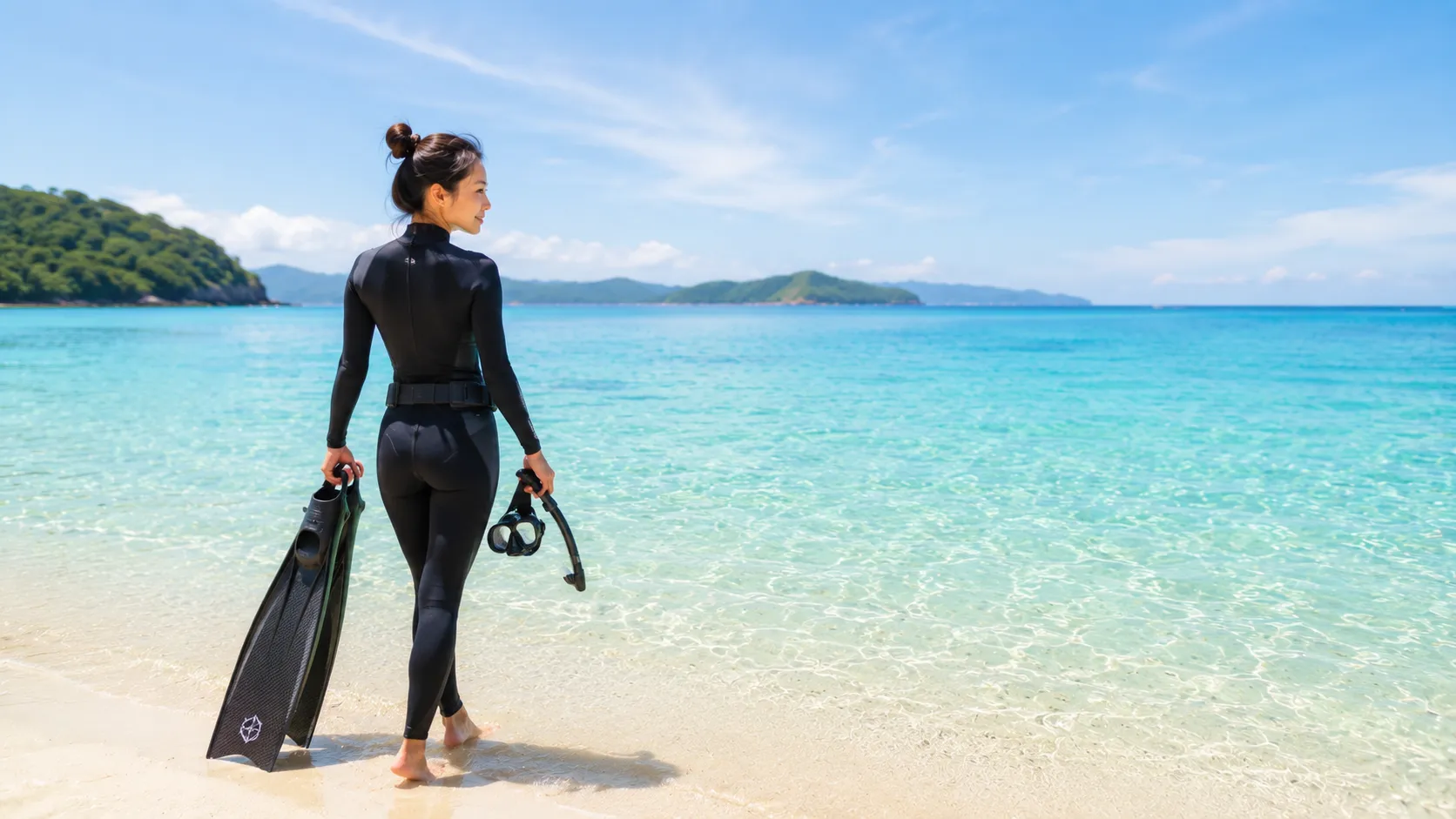
What Is Freediving?
Simply put, freediving is diving underwater on a single breath, without any oxygen supply equipment. In a broad sense, even if you put your face in the water and hold your breath, you are already “doing” freediving.
Many people think freediving is a game for a few exceptionally gifted people, but that is not true. Like whales and dolphins, humans are born with the “mammalian dive reflex”—when the face enters cold water, the heart rate automatically slows, and blood is prioritized to the brain and heart, allowing the body to use oxygen more efficiently underwater. This is not a special talent; it is an instinct written in our genes, and it can be awakened through course training.
The current world record for finned freediving is 136 meters, but the assessment target for the AIDA2 entry-level course is only 12 meters. You are not trying to become an athlete; you just want to see what the underwater world looks like.
What Is the Difference Between Freediving, Snorkeling, and Scuba Diving?
Many people confuse freediving with snorkeling. The core difference is simple: snorkeling is looking down from the surface, while freediving actually takes you underwater.
The difference between scuba diving and freediving is “how you breathe.” Scuba diving involves carrying a cylinder and breathing continuously underwater, while freediving is descending on one breath and returning on that same breath.
Freediving | Scuba Diving | |
|---|---|---|
Main equipment | Mask, snorkel, long fins, wetsuit | Cylinder, regulator, BCD |
Underwater time | 1-3 minutes per dive | 30-50 minutes |
Underwater experience | Silent; the closest sense of connection to the ocean | Breathing sounds; it is harder for marine life to come close |
Entry-level course fee | About 2,500-4,000 yuan (AIDA2) | About 3,000-5,000 yuan |
Learning focus | Breath-hold, relaxation, equalization | Breathing control, buoyancy control, equipment operation |
There is no required order for which to learn first; it depends entirely on what kind of experience you want. If you want freedom, quiet, and to swim at the same level as schools of fish, choose freediving.
Is Freediving a Dangerous Sport?
You may have heard the saying “freediving is the world’s second most dangerous extreme sport.” This is a widely circulated misconception.
With formal course training and strict adherence to the buddy system, freediving can be a safe activity. The biggest risk in freediving is shallow-water blackout, a loss of consciousness caused by low oxygen. Courses teach you how to recognize and avoid it, and also teach your buddy how to respond.
The most important safety rule: never dive alone. No exceptions.
Can I Learn Freediving If I Cannot Swim?
Yes. The core of freediving is not swimming skill, but breathing control, snorkeling skills, and physical and mental relaxation.
Courses in each system usually include a swim test, but most allow it to be completed with a mask and snorkel; formal swim strokes are not required. However, if you are clearly afraid of water, it is recommended to take a few basic swimming lessons first to address the fear of water; then you will learn much faster.
Can I Learn If I Can Only Hold My Breath for 20 Seconds?
This is the least of your worries. Breath-hold time can be significantly improved through a course.
Many people try holding their breath at home before signing up, find they cannot last past 20 seconds, and think they are not suited to this sport. But after the course, holding your breath for more than a minute under an instructor’s guidance is really not a problem. One of the core parts of a freediving course is teaching you how to use correct breathing techniques and relaxation skills so your body uses oxygen more efficiently.
Do I Need Certification for Freediving?
If you just want to experience it once with an instructor, you do not need certification; just sign up for an introductory experience class (about half a day, a few hundred yuan).
But if you want to learn safely and systematically and be able to freedive at dive sites worldwide, certification is necessary. Going to depth without systematic training is like driving on the road without learning traffic rules—you do not know where the dangers are.
What Freediving Certification Agencies Are There?
Currently, the main freediving certification agencies worldwide include:
Agency | Features |
|---|---|
AIDA | International Association for the Development of Freediving, the most established freediving organization, focused on competitions and record certification |
SSI | International Scuba Diving School, with a complete curriculum covering freediving, scuba, and mermaid |
PADI | The world’s largest dive training system, with a mature freediving curriculum and globally recognized certifications |
Molchanovs | Founded by a legendary freediver, known for scientific and rigorous training methods |
Choosing an instructor matters more than choosing a system. The course content across systems is largely similar; the instructor’s style and teaching approach affect you far more than the system itself. Finding an instructor you trust and can communicate with comfortably is more important than agonizing over which system to choose.
What Do You Learn in a Freediving Course? How Long Does It Take?
Using AIDA2 (entry-level course) as an example, it usually lasts 3 days and includes:
Theory: fundamentals of freediving physics/physiology, safety knowledge
Confined water training: static apnea, dynamic apnea, breathing techniques, relaxation training
Open water training: duck dive, equalization, constant weight descent (target 12 meters), rescue practice
After the course, you must pass an assessment to be certified; certification is not automatically issued just for completing the course. AIDA2 assessment standards usually include: static apnea 2 minutes, dynamic apnea 40 meters, constant weight descent 16 meters (varies slightly by system).
If you do not pass, you can usually retake the assessment within one year.
What Equipment Do You Need for Freediving?
During the course, most equipment can be rented; you only need to prepare:
Swimsuit
Dive socks (or regular socks are fine)
A willingness to try
Equipment provided by the course includes: mask, snorkel, long fins, wetsuit, and weight belt. Once you are sure you like it, then consider buying your own equipment.
The three pieces of equipment most worth investing in for beginners: mask (low volume), snorkel, and long fins. The material of long fins directly affects propulsion efficiency in water. Plastic (about 2,000-4,000 yuan) is sufficient; fiberglass (about 5,000-10,000 yuan) is more responsive and lighter; carbon fiber (over 10,000 yuan) is chosen for maximum efficiency.
How Deep Can You Go in Freediving? How Deep Can I Dive?
The target depth for the AIDA2 entry-level course is 12 meters. For someone new to freediving, with a professional instructor, reaching 3-5 meters on the first day is easy. As you become more familiar, 10 meters or more is not difficult.
Depth is not the goal; safety and relaxation are the focus. You do not need to compare yourself with world records; you only need to compare with yourself.
Is Freediving Expensive?
Prices vary by agency and location; for reference:
Course | Cost | Days |
|---|---|---|
Introductory experience class | About 500-1,000 yuan | Half day |
AIDA2 (entry-level) | About 2,500-4,000 yuan | 3 days |
AIDA3 (advanced) | About 4,000-5,000 yuan | 4 days |
AIDA4 (higher level) | About 5,000-6,000 yuan | 4 days |
Before accepting a quote, be sure to ask clearly whether the fee includes: equipment use, facility fees, certification application fees, and insurance. Some courses may look cheap, but if all these costs are charged separately, the total may not be a good deal.
Where Can I Learn Freediving? Where Can I Dive?
Popular learning locations in China: Sanya, Shenzhen, and Nanning. Nanning is one of China’s best-known freshwater diving destinations, with good water quality, high visibility, and sufficient depth.
Overseas freediving destinations: the Red Sea in Egypt, Bali, Bohol in the Philippines, and Koh Tao in Thailand (the most cost-effective for certification).
Common Freediving Questions Q&A
Q: Do I need to know how to swim for freediving?
A: Not necessarily, but it is recommended that you are not afraid of water. Swim tests in each system allow the use of a mask and snorkel.
Q: What is a normal breath-hold time in freediving?
A: For beginners, 30 seconds to 1 minute is normal; after taking a course, most people can generally reach over 2 minutes.
Q: Can I learn freediving if I am nearsighted?
A: Yes. It is recommended to wear contact lenses + a non-prescription mask, or order a custom prescription freediving mask.
Q: Can I learn freediving in winter?
A: Yes. Wearing a wetsuit keeps you warm, and in the off-season there are fewer tourists and visibility is high, so class quality can actually be better.
Q: Is there an age limit for freediving?
A: AIDA2 requires 15 years of age or older. In other countries, many older adults start learning in their 60s or 70s; freediving is a sport that can be practiced throughout life.
Where to Start?
After reading this article, you already know all the basics of freediving.
Your next step:
Not sure whether you will like it → sign up for a half-day introductory experience class
Decided to learn systematically → contact a certified instructor and sign up for AIDA2
Want to learn more → follow our upcoming in-depth content