Freediving for Beginners | Everything You Need to Know Before Your First Time in the Water
 Freediving for beginners
First, the question you care about most: can someone with no experience who cannot swim learn freediving? My position is this — you do not have to be a competitive swimmer, but you must meet the minimum swimming, treading-water and open-water comfort requirements set by the course you plan to take; if you panic easily in the water or cannot swim on your own, you should not begin breath-hold training.
If you already have basic comfort in the water, this article is for you: a full run-through of gear, mindset and physical preparation, and what you will actually face the first time you get in the water.
Three Things to Sort Out Before You Get in the Water
1. Health screening matters more than anything else
Freediving places higher demands on the cardiovascular, respiratory and ear, nose and throat systems than most people expect. Before signing up for any course, first check whether any of the following apply to you: asthma, epilepsy, heart disease, high blood pressure, chronic sinusitis, a history of eardrum perforation, or a history of lung surgery. If you have any doubt, consult a doctor first — do not "give it a try and see".
2. Find a reputable course
Do not have a friend teach you, do not teach yourself from videos, and do not join a "two-day crash course". Entry-level freediving courses are usually offered by certification agencies such as AIDA, PADI, SSI and FII. They last 2-4 days and include three stages: theory, confined water (pool) and open water. Before you sign up, confirm: whether the instructor holds a current, valid teaching certification; whether the course includes buddy supervision and BO recognition and rescue; and whether it includes open water dives (if what you need is a complete entry-level course rather than a pool-only course).
3. You only need three pieces of gear: mask, fins, snorkel
Entry-level courses usually provide gear, but if you are buying your own, the order of priority is:
- Low-volume mask (small volume saves air during equalization and makes Frenzel easier. Do not buy a large snorkeling mask)
- Long bi-fins (fiberglass, medium-soft stiffness, one fin per foot. Do not buy a mermaid monofin, and do not use short scuba fins)
- Snorkel (a simple J-tube; do not get a complex model with a purge valve and splash guard)
- Wetsuits and weight belts are usually provided by the dive shop — wait until after the course to buy them
Your First Time in the Water: What to Expect
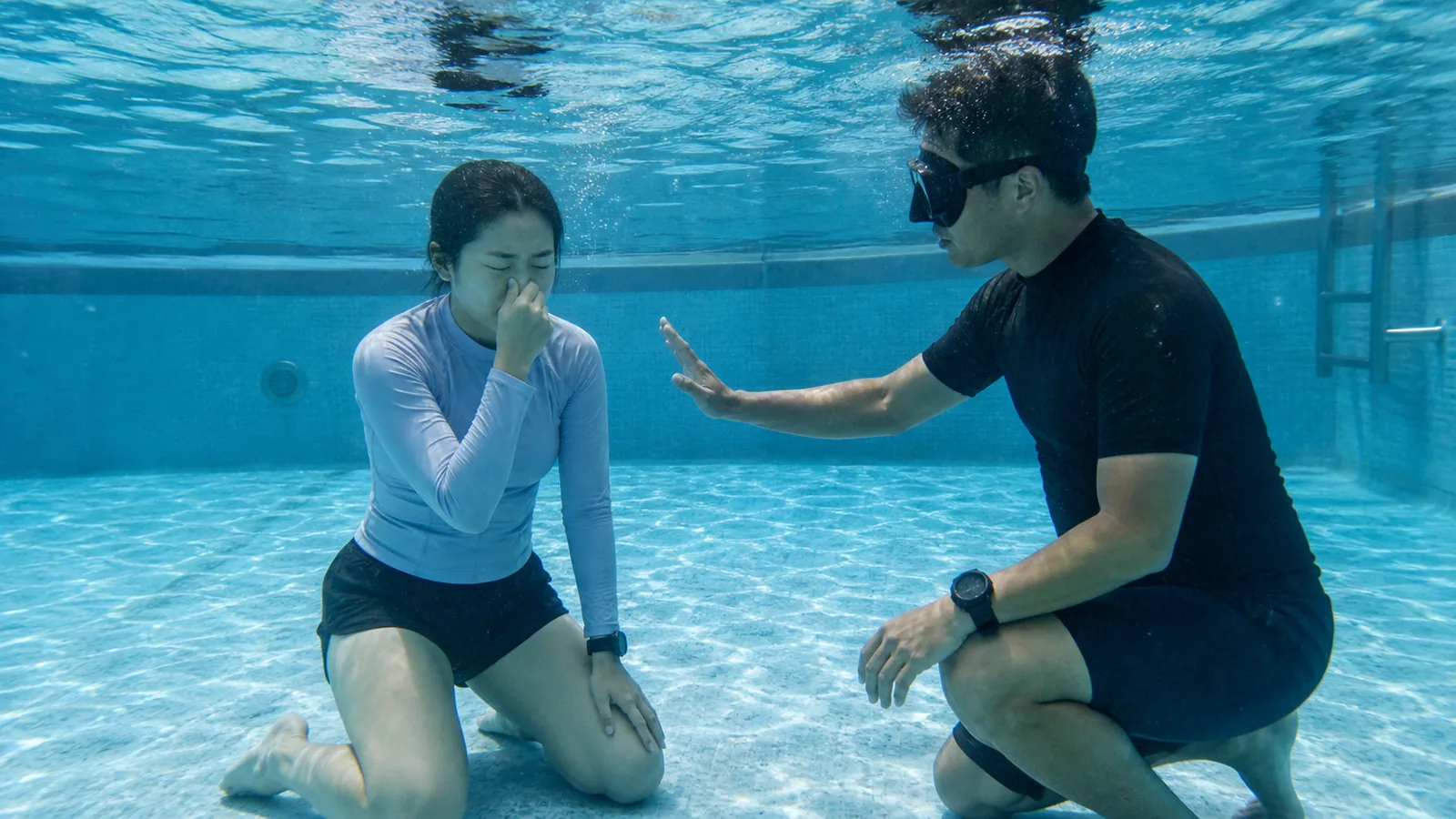
Pool / confined water session (usually 2-4 hours)
The instructor will first have you practice relaxed breathing at the surface — not "deep breathing", but natural, slow tidal breathing. Then you may be asked to try a short static apnea hold. The point is not how long you hold your breath, but learning to relax — so that the contractions of your diaphragm no longer frighten you.
Next comes basic safety training: buddy supervision procedures, hand signals, and drills for recognizing and rescuing a BO. You will notice that the first session spends more time on safety than on anything else. This is not wasted time — it is a required part of freediving.
Open water session (usually in the second half of the course)
Once in the water, the instructor will take you through each skill one by one: duck dive, equalization (Frenzel), constant weight descent (CWT), streamlined posture, ascent and recovery breathing. Throughout the whole process, the instructor or your buddy stays right beside you, and after every dive they check that you are stable when you surface.
Five Mistakes Beginners Make Most Often
| Mistake | Why it is wrong | What to do instead |
|---|---|---|
| Taking several big breaths before getting in the water | Hyperventilation; increases the risk of BO | Breathe naturally, and take the final breath as your instructor directs |
| Only equalizing once your ears hurt | By then it is too late; injury is likely | Equalize early, gently and often — every 1-2 meters of descent |
| Staring at your depth gauge | Increases anxiety and raises oxygen consumption | Focus on how your body feels and how relaxed you are, not on the numbers |
| Surfacing only when you reach your limit | Pushes your safety margin to its limit, leaving no room to spare | Start your ascent while you still feel comfortable, keeping a margin |
| Competing with the person next to you over who can hold their breath longer | Freediving is not a competition; comparing times is how accidents happen | Compare only with yourself, on how relaxed you are |
Beginner FAQ
Q: I swim slowly and do not have a large lung capacity — can I learn freediving?
A: Freediving does not depend on a large lung capacity; it depends on relaxation and efficiency. Many skilled freedivers do not have remarkable lung capacity, but they are extremely relaxed underwater and use very little oxygen. Lung capacity is only a starting point — relaxation is the core.
Q: What if I get scared the first time I get in the water?
A: That is normal. Most people feel instinctive tension when facing deep water. A good instructor will not rush you with "don't be afraid", but will build your confidence step by step — starting in shallow water, letting you practice in an area where you can stand up at any time, and only going deeper once you have adapted.
Q: How soon after the course can I dive to 20 meters?
A: People vary widely, depending on how often you train, your physical condition and your instructor's plan. Some people reach 16-20 meters right after the course; others need several weeks of extra training. Do not use depth to measure progress — how relaxed you are and your posture underwater are more important indicators.
Q: Do I need to know yoga to freedive?
A: No. Yoga breathing practice and flexibility support freediving, but they are not a requirement for starting. After you begin freediving, you can add yoga or Pilates training as you see fit.
The biggest enemy of a new freediver is not deep water, not ear pressure, and not holding your breath — it is anxiety. The more tense you are, the faster you use oxygen; the more relaxed you are, the deeper you go. So the first piece of advice is not "learn to hold your breath" but learn to be calm underwater. When you first float quietly in clear blue water with nothing but your heartbeat in your ears, you will understand why so many people fall in love with this sport.
This article is for general information only and does not constitute any instructional advice. Freediving is a high-risk activity; please train under the guidance of a certified instructor and with a complete buddy system. If you have any health concerns, consult a doctor first.