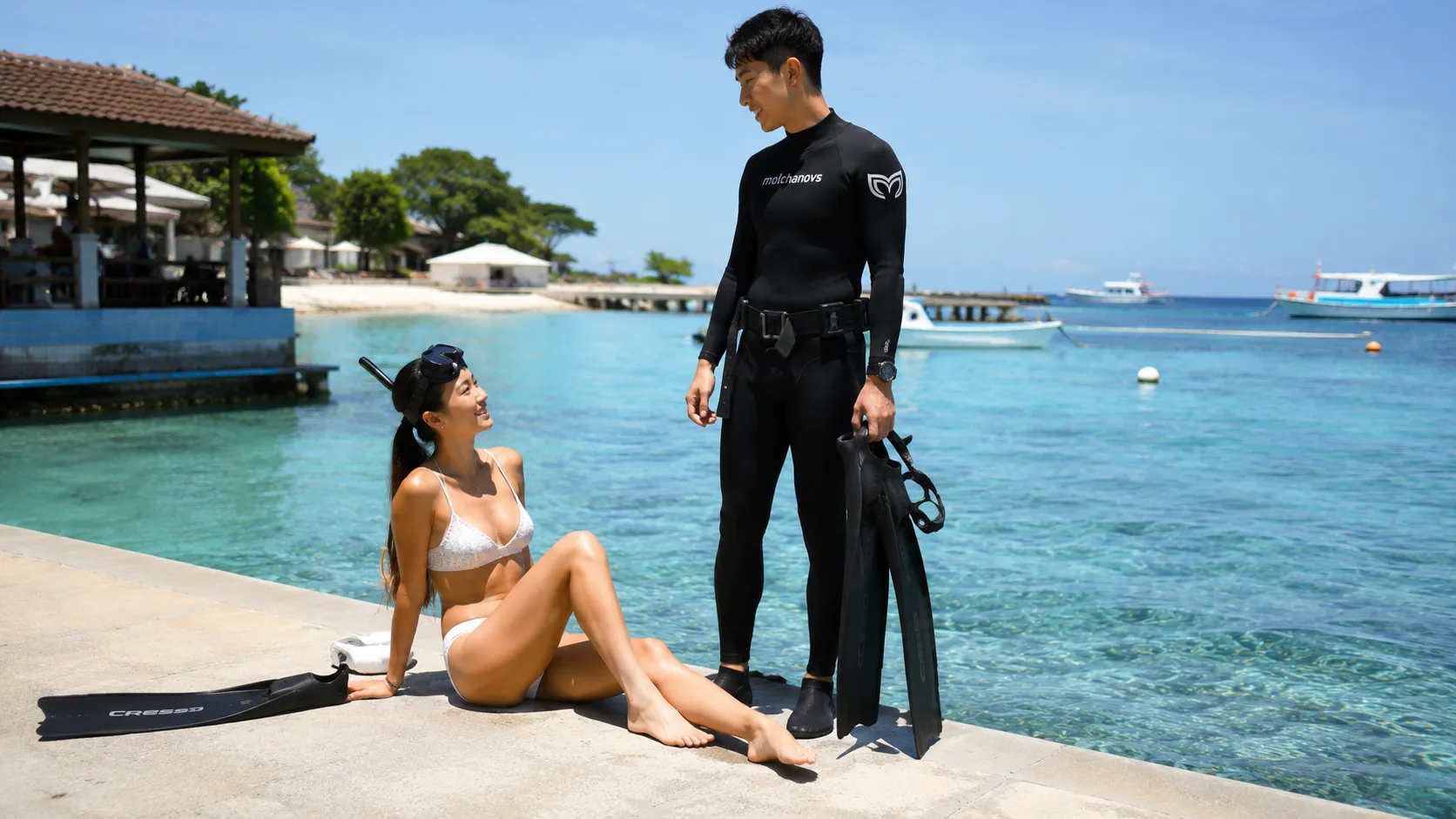
First, the core question: Do you need a freediving certification?
Not necessarily.
If you just want to try it once, descend to 3-5 meters with an instructor, and feel what it is like underwater—no certification is needed. You can simply sign up for a half-day experience class.
But if you want to learn freediving safely and systematically, and to dive independently at dive sites worldwide—certification is essential. Going deep without systematic training is like driving on the road without learning traffic rules: you do not even know where the dangers are.
The essence of freediving certification is systematic learning of safety knowledge, breathing techniques, and equalization. The certificate is only proof of this learning process. It shows that you have the basic skills needed to descend safely—not that you are “very skilled.”
These 5 types of people can enjoy freediving without certification
1. People who just want to try it once
You are just traveling to an island and want to try freediving while you are there. With a dive guide, no certification is needed—you only need to join a “Freediving Experience” program. Depth is usually kept to 3-5 meters, and the cost is about 500-1000 yuan.
2. People who want to take a set of underwater photos
If you just want a set of underwater photos as a memento, certification is not required either. Many underwater photography services include simple freediving instruction, and the photographer will take you to shallow water for the shoot. You only need to know how to snorkel and not be afraid of the water.
3. People who are not sure whether they will like it
“I do not know if I can adapt to freediving”—this is the most common hesitation. Instead of spending several thousand yuan on certification, try a one-time experience class for a few hundred yuan first. If you like it, continue; if you do not, there is no loss.
4. People who only practice in a pool
Some freediving clubs offer pool experience courses that do not involve open water. If you just want to experience a breath-hold and the feeling of being in the water, these courses do not require certification at all.
5. People who can already freedive but have no certification
Some people have learned on their own or with friends and already have basic breath-hold and descent skills. If you do not plan to get certified and just dive for fun, you can of course skip certification. But please be sure to: find a buddy, and do not dive alone. Without systematic training, you do not know how great the risk of shallow-water blackout is.
The core value of certification is not the certificate—it is safety
The core value of freediving certification is not that certificate. It is that it helps you systematically learn safety knowledge, breathing techniques, and equalization.
The certificate is only proof of the learning process. Through certification, you can truly understand: how to recognize the risk of shallow-water blackout, how to equalize correctly, and how to work with a buddy to perform a rescue.
This knowledge and these skills are the most valuable things in freediving.
Who must get certified?
Situation | Reason |
|---|---|
Want to freedive at dive sites worldwide | Most dive sites require a freediving certification before allowing you to enter the water |
Want to dive in deep water (>10 meters) | As depth increases, risk rises exponentially, so systematic training is needed |
Want more people to recognize your professionalism | With or without certification, the level of trust is completely different |
Want to learn freediving systematically | The certification process itself is an effective learning path |
Want to continue advancing with an instructor | Without taking Level 2, you cannot take Level 3, and you cannot go deeper |
Certification vs. no certification: see it in one table
Dimension | Certification | No certification (experience/wild diving) |
|---|---|---|
Depth | Can reach 16-24 meters (Level 2/Level 3) | Usually no more than 5 meters |
Safety | Systematic learning of safety knowledge + rescue skills | Rely only on intuition and luck |
Equalization | Learn the Frenzel technique | Force it, which can easily cause injury |
Dive sites worldwide | Can dive with certification | Most dive sites refuse entry without certification |
Cost | 2500-4000 yuan | Experience class: a few hundred yuan |
Time commitment | 2-3 day course | Half a day |
The most important question is not “Do you need a freediving certification?” but “Is freediving safe?”—certification is the only way to answer this question.
Frequently Asked Questions (FAQ)
Q: Is the freediving experience safe?
Yes. With a professional instructor, depth is kept to 3-5 meters, which is a safe range in freediving.
Q: How deep can I dive without certification?
In instructor-led experience programs, usually no more than 5 meters. Diving deeper on your own is not recommended.
Q: What is the certification pass rate?
The AIDA Level 2 pass rate is about 60%-70%. Equalization is the main sticking point. If you do not pass, most schools allow a retest, so there is no need to worry too much.
Q: I already have a PADI scuba diving certification. Do I still need a freediving certification?
Yes. Freediving and scuba diving are completely different skill systems. Scuba diving experience cannot replace freediving training.
Summary
If you just want to experience the fun of freediving, not getting certified is completely fine. Sign up for an experience class, descend to 3-5 meters with a professional instructor, and feel the quiet and freedom underwater—that is enough.
But if you want to explore the deeper underwater world safely, certification is a necessary investment. What it gives you is not a certificate, but all the knowledge that lets you descend and ascend safely.