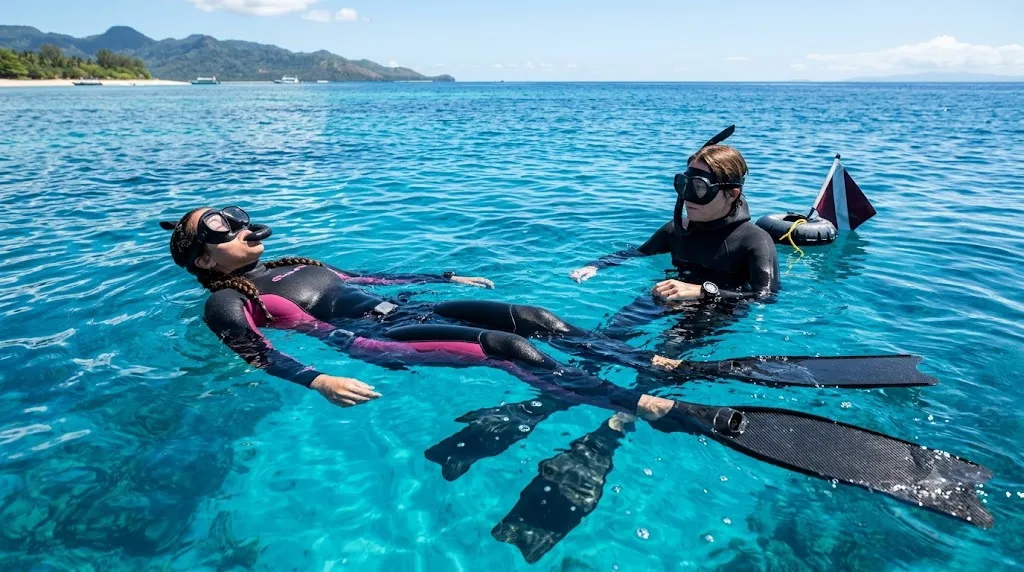
Is Freediving Dangerous?
Freediving has risks, but the vast majority can be prevented and controlled.
It is like driving—drunk driving, speeding, and not wearing a seat belt are of course dangerous. But if you follow the rules and stay focused, it is a relatively safe activity. Freediving is the same: not diving alone, not hyperventilating, following depth limits, and diving with a competent buddy—the risk is acceptable.
This article lists risks from highest to lowest severity of consequences.
1. Shallow-Water Blackout (BO—Blackout)
This is the most fatal risk in freediving, bar none.
Shallow-water blackout means a diver loses consciousness during ascent because the brain is deprived of oxygen. It most often occurs in the final stage of the ascent (especially between 3-5 m from the surface), because pressure changes in shallow water have the greatest effect on gas partial pressure—from 10 m to the surface, pressure drops from 2ata to 1ata, gas volume doubles, and oxygen partial pressure falls sharply.
Key facts:
Shallow-water blackout usually has no clear, reliable warning signs. Even if some people experience signs such as blurred vision or confusion, they are either missed or occur too late to react.
It can happen to anyone—including world record holders.
The cause is not that the diver is “not good enough,” but that the brain’s oxygen supply is not enough to maintain consciousness.
How can it be prevented?
Never dive alone: this is the most important rule, with no exceptions.
Do not hyperventilate (see below).
Follow depth limits: do not attempt depths you have not trained for.
Maintain good surface intervals: let your body recover fully.
Why does BO happen?
During descent, as pressure rises, the partial pressure of oxygen in the alveoli rises, and the body feels it has “plenty of oxygen.” But during ascent, pressure falls, oxygen partial pressure drops sharply, and in the final stage the brain rapidly depletes its oxygen reserves. Once brain oxygen partial pressure falls below a critical level, consciousness is lost instantly—the change from “feeling fine” to “losing consciousness” may take only a second or two.
With the help of the diving reflex (MDR—mammalian dive reflex), the body actively lowers heart rate and slows oxygen consumption, but this protective mechanism is limited.
2. Lung Squeeze
In freediving, the deeper you descend, the greater the pressure on the chest. If the body has not adapted to the depth change, lung tissue may be injured.
Common symptoms: chest pain, coughing up blood, difficulty breathing.
Prevention:
Do not “force a descent.” Physical discomfort is a signal—stop and ascend.
Increase depth gradually.
Maintain good stretching so the diaphragm has enough flexibility. Daily diaphragm stretching can significantly reduce the risk of squeeze injuries.
3. Ear Barotrauma
This is the most common injury among freedivers. If you do not equalize promptly during descent, the pressure difference between the inside and outside of the middle ear may become too great and cause eardrum perforation.
Prevention:
Start equalizing at the surface; do not wait until it hurts.
Equalize every 0.5-1 m of descent.
If you feel ear pain, stop the descent immediately, ascend a little, and try again. Do not push through.
Golden Rules for Freediving Safety
1️⃣ Never dive alone (the most important rule)
No exceptions. After a BO, your buddy is your only hope of survival.
World record holder Alexey Molchanov has said: “In every BO during my training, it was my buddy who saved me.”
Buddy responsibilities: watch your buddy throughout the entire descent and ascent; stay near the surface and be ready to help while your buddy ascends; if you notice anything abnormal, rescue immediately.
2️⃣ Do not hyperventilate (do not overbreathe)
Hyperventilation means taking many rapid, deep breaths before a dive. This removes too much CO₂ and delays the onset of the urge to breathe. When blood CO₂ is too low, even if O₂ is depleted, the body does not give the “I can’t hold my breath any longer” warning—the result is that you black out from lack of oxygen without ever feeling the urge to breathe.
The correct approach: slow, relaxed deep breaths, not rapid deep breathing.
3️⃣ Follow depth limits
Do not attempt depths you have not trained for. AIDA 2-star requires 16 m, and 3-star requires 24 m—train to meet the standard, and do not rush to attempt deeper depths.
4️⃣ Maintain good surface intervals
Surface intervals should be at least 3 times the dive time or more. For example, after a 1-minute dive, rest at least 3 minutes before diving again.
What to Do if a BO Occurs? Buddy Rescue Procedure
Approach quickly, bring your buddy to the surface, remove the mask, and check consciousness and breathing.
If there is no consciousness and no breathing, clear foreign objects from the mouth, open the airway, and begin in-water rescue ventilations (surface artificial respiration).
Continue ventilations until your buddy resumes spontaneous breathing or emergency responders arrive.
After recovery, if emergency oxygen equipment is available, give high-concentration oxygen to support recovery and continue monitoring.
Frequently Asked Questions
Q: Which is more dangerous, freediving or scuba diving?
The two have different types of risk. The main risks in freediving are hypoxia and BO; the main risks in scuba diving are decompression sickness and equipment failure. The most important thing is to receive systematic training and follow safety rules, not to compare which is “more dangerous.”
Q: What aftereffects can BO cause?
A BO from which recovery is rapid usually does not cause long-term aftereffects. But repeated, unwitnessed BO can lead to irreversible neurological damage. This is why the buddy system is so important.
Q: Is it safe to practice breath-hold alone?
For static apnea (STA) training on land, having someone present to supervise is recommended. If you must train alone, it is not recommended to exceed 1 minute, and avoid doing it in a lying position (to prevent falls from fainting during recovery).
Q: Do I need insurance for freediving?
Yes. Standard travel insurance does not cover the risks of freediving. It is recommended to buy insurance specifically covering freediving (such as DAN diver insurance).
The greatest danger in freediving is not descending too slowly, but running out of air on the way back.
BO is a risk every freediver must learn to face. But through systematic training, following safety rules, and diving with a reliable buddy, you can safely enjoy the sport.